I’ve got lots to talk about in this post, so you maybe want to have a cuppa handy first! In fact, this experience was so epic, this is a blog post of two halves, and there will be a second instalment on its way next week.
I recently went on a foraging trip with friends, led by Zoë from Wild Food Arran. You can explore her website
and social media accounts here:
https://www.wildfoodarran.com/
https://www.wildfoodarran.com/blog
https://www.instagram.com/wildfoodarran/
https://www.facebook.com/WildFoodArran

Our foraging workshop took place on the coast, at Brodick, five minutes from where the ferry gets in. It’s easy to imagine a trek through fields and woodland – but we collected the ingredients for our lunch across a very short distance. And it was fascinating to discover how much variety there was in such a small pocket of land – more than we could learn in one hour.
I will just say that I have been somewhat vague about the plants I wasn’t already familiar with. I’m not a forager, so this post isn’t intended to clearly identify all of the plants we harvested, some of which could be confused with toxic plants. Zoë’s Instagram and blog pages will give more informed descriptions of some of the things we found, and safe methods of identification.
Apart from recognising blackberries or nettles and wild garlic, I don’t tend to try and identify edible plants myself as I don’t know enough to eliminate poisonous lookalikes. It was interesting to hear how subtle identification can be – mushrooms require skilled knowledge, and so do the umbellifer flowers of the carrot family. I am enjoying learning the differences between umbellifers for the purposes of embroidery, but the difference in flowers or leaves is not thorough enough to be safe for foraging. I always find myself looking in the hedgerow telling myself, “Ooh, cow parsley (well, possibly fennel, possibly hemlock, don’t know really)”. That’s why I just take photos and save tasting for blackberries…
Foragers make a point of emphasising that we should never eat anything unless we are 100% certain that we recognise it as safe. Poisoning is largely down to mis-identification, so it’s important to know which features indicate edible plants, and which will tell you something is poisonous. Again, Zoë’s pages will point you in a better direction than I can.

Starting on the beach, Zoë showed us seawort – a familiar-looking plant, but I didn’t know its name, or that it tasted something like cucumber. Similarly, looking at the seaweed, I could recognise bladderwrack, but not channelled wrack or spiral wrack. Until we looked more closely it was hard to realise that there were several different types of seaweed growing all together. I also didn’t appreciate that seaweed is a type of algae, which I tend to associate with the slimy, cloudy green clumps found in ponds and lakes, rather than with robust organic forms.

It’s important to only harvest living seaweed, rather than detached pieces that have been decomposing. This means snipping pieces off here and there, rather than pulling any seaweed free from the rocks. It is particularly important not to cause damage to organisms while foraging, or to over-harvest them so that they cannot recover quickly.
Moving a little inland we came across large leafy clumps of sea radish. Zoë harvested these leaves very carefully, because they were growing quite near to hemlock water dropwort, which is extremely deadly. All the harvesting was also done within thickets, a little beyond the more open areas where dogs may have been.
The sea radish did have a recognisably radishy bite, and provided a good handful of large leaves for a soup. Then a little further on was one of the biggest surprises of the day. Although a horribly invasive and generally unpopular plant, young Japanese knotweed shoots are good to eat. Like three-cornered leeks, which are also invasive, this is a plant that foragers can collect as much of as they like. This can benefit native plants in the area which struggle against such aggressive competition.
We harvested the shoots we could find, as well as picking up any litter we came across. This is another important facet of foraging etiquette – a way of appreciating nature by helping to protect it. Most of the young knotweed shoots were collected for lunch, but we also tried them raw. They had a tang which was quite similar to rhubarb.
Just beyond the knotweed we saw little clusters of plantain. We didn’t eat this, but the juice from the leaves is even better at relieving nettle stings than dock leaves. Incidentally, the plants that looked somewhat dock-ish to me were actually wild horseradish. This plant is also safe, but I wouldn’t have known that without Zoë identifying it. You can see what foragers mean about being 100% certain – it’s really not the sort of thing that’s safe for educated guesses!

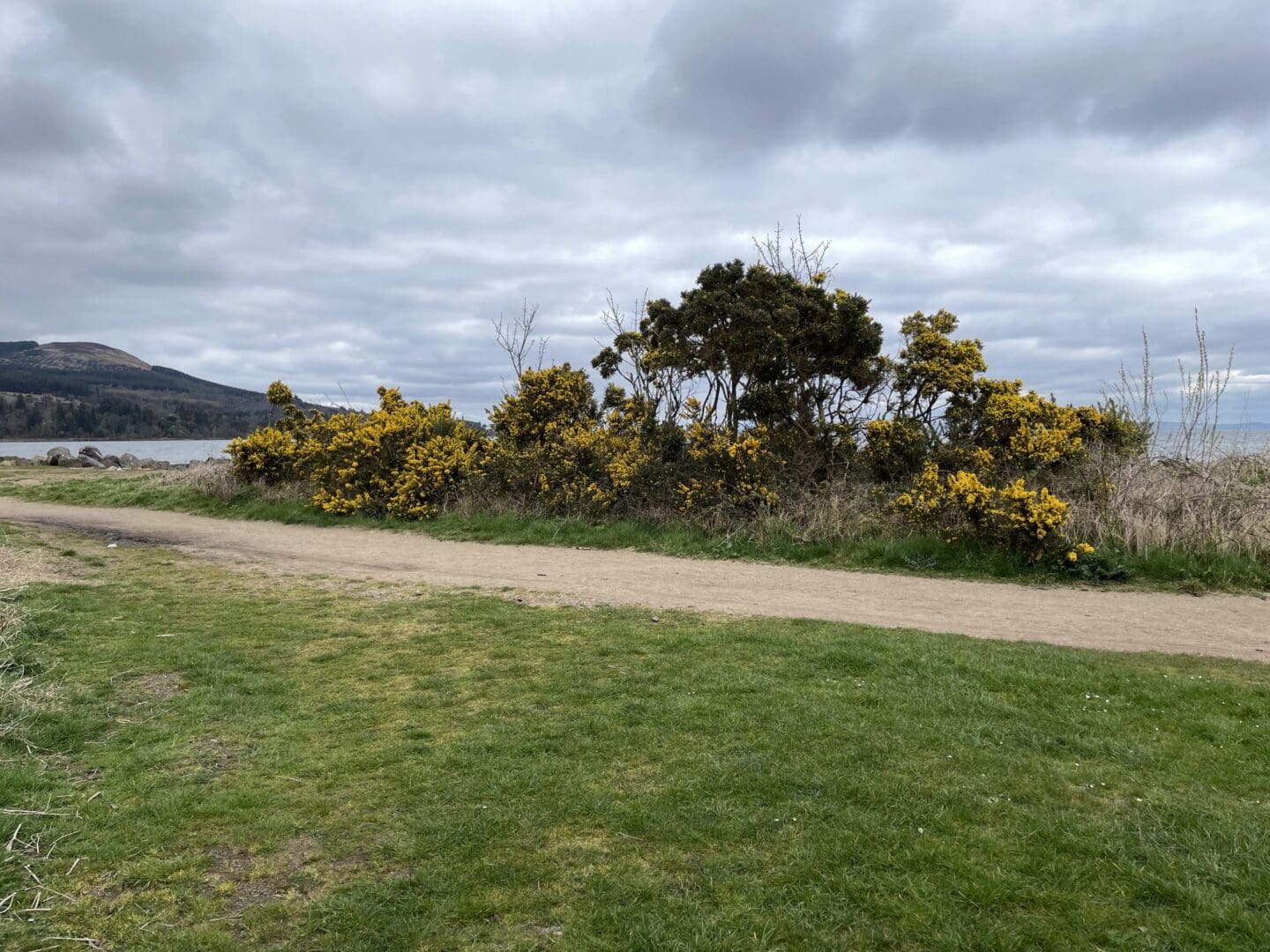
Only a few steps on and we found three different edible plants almost on top of each other. Behind thickets of gorse and a few brambly tangles, there were clumps of sorrel on the ground. The leaves tasted of apple peel – always a lovely thing to eat – but with an extra tang like lemon. We collected a good handful of these.
We were confident about identifying blackberry plants and gorse, but we had no idea that gorse flowers were edible (though not suitable for pregnant women), and that young blackberry leaves and buds can be eaten or used to make tea.
On a very sunny day, gorse flowers can taste of coconut. On this occasion they had a strong coconut scent (new to me – usually I think of vanilla), but there wasn’t much taste in the petals. The blackberry leaves were mostly leafy and musty, with a faint blackberry taste at the end. I probably won’t eat many blackberry leaves, but I’m waiting for summer to try the gorse again to see if that coconut taste comes out.
Thank you for accompanying me so far – keep an eye out for the second half of this experience next week!