Posted on — Leave a comment

Illuminating Safety: The Ultimate Guide to Candle Safety

Candles have a magical way of transforming a space, filling it with warmth, comfort, and ambiance. However, amidst the allure of candlelight, it’s vital to prioritize safety. From proper wick trimming to knowing when to extinguish, here’s everything you need to know to enjoy candles responsibly:

1. Trim the Wick:

Before lighting your candle, trim the wick to approximately 5mm. This prevents excessive smoke and ensures a clean, even burn.

2. Allow Wax to Pool:

For an optimal burn, let your candle burn until the wax pools out to the edge of the container. This encourages an even burn and minimizes wax waste.

3. Burn Time Limit:

While indulging in candlelight, remember not to exceed 4 hours of continuous burning. Ideally, keep it between 2 to 3 hours to prevent overheating.

4. Re-Lighting Ritual:

If you need to re-light your candle, wait until the wax has solidified. This prevents splattering and maintains the integrity of the wax.

5. Know When to Say Goodbye:

When there’s about 1/2 inch of wax left at the bottom of the container, it’s time to bid adieu to your candle. Burning it further risks damaging the container and can be a fire hazard.

6. Snuff It Out:

Use a candle snuffer to extinguish the flame instead of blowing it out. This minimizes smoke and prevents hot wax from splattering.

7. Keep It Away:

Keep candles out of reach of children and pets. Curiosity can quickly turn hazardous, so it’s essential to maintain a safe distance.

8. Never Leave Unattended:

Perhaps the golden rule of candle safety—never leave a burning candle unattended. Even a momentary distraction can lead to disaster.

Additional illuminating Insights:

Soy Wax Frosting: If you notice a frosted appearance on your soy wax candle, don’t panic. This natural phenomenon, known as frosting, is common and doesn’t affect the candle’s burn quality. Embrace it as a characteristic of soy wax candles.

Incorporating these safety practices into your candle routine ensures not only a tranquil ambiance but also peace of mind. So, light up your space, immerse yourself in the gentle glow, and bask in the warmth of candlelight, knowing that you’re doing so responsibly.


Posted on — Leave a comment

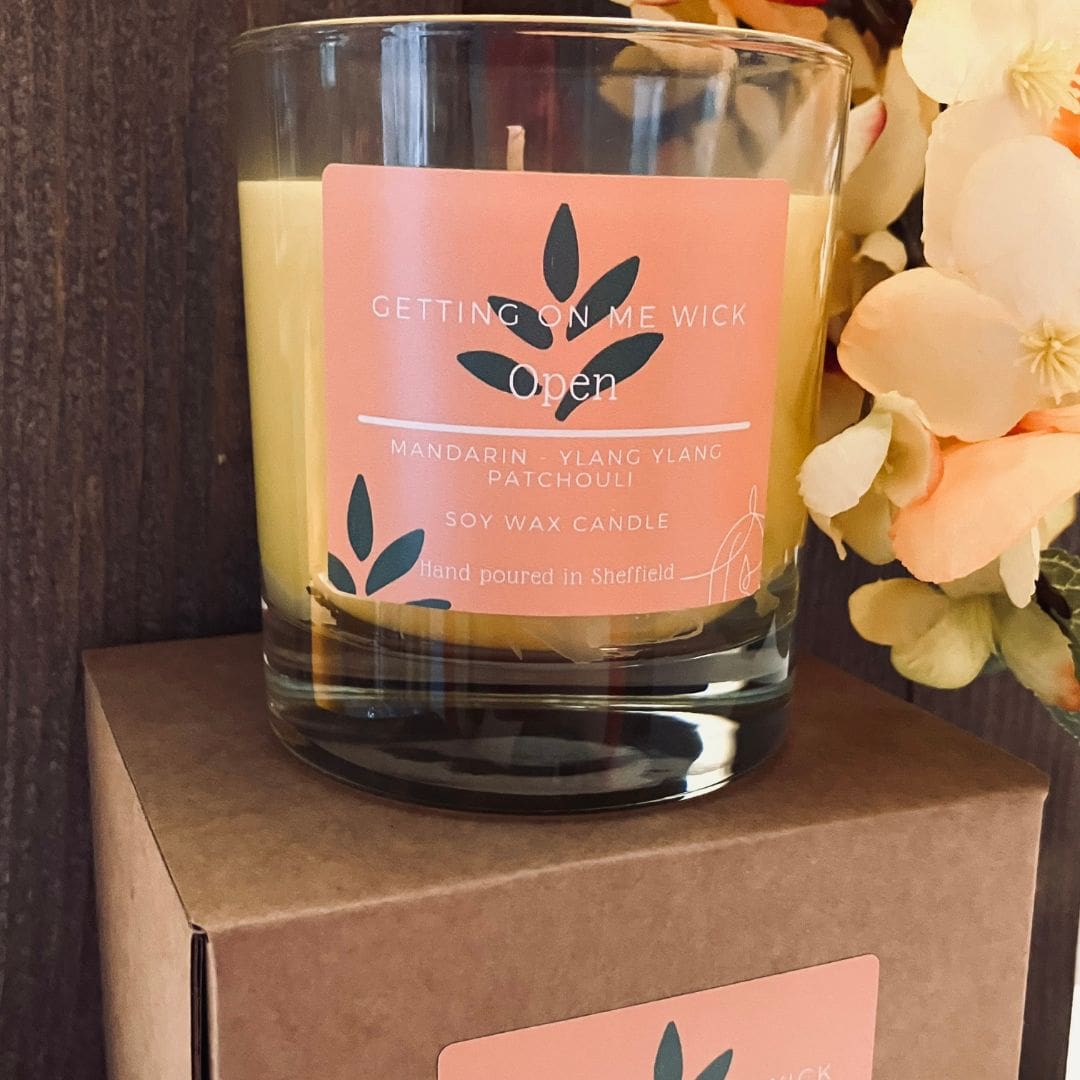
Embrace your true self – the magic of an Open Candle

In a world that often demands conformity, where the pressures of daily life can stifle our creativity and dampen our spirits, there’s something truly liberating about embracing our authentic selves. It’s about tuning in to the essence of who we are, nurturing our passions, and igniting the flames of creativity that burn within us. And what better way to embark on this journey of self-discovery than with the gentle flicker of an Open Candle?


Crafted with care from organic soy wax and a blend of essential oils—mandarin, ylang-ylang, and patchouli—this candle isn’t just a mere accessory for your space; it’s a powerful tool for tapping into the sacral energy that resides within each of us. The sacral chakra, the energy centre located in the lower abdomen, is associated with creativity, passion, and the free flow of emotions. By harnessing the potent properties of these essential oils, the Open Candle becomes a beacon of light guiding us towards our true selves.

Picture this: as you light the wick of the Open Candle, the room fills with the soothing aroma of mandarin, its citrusy notes awakening your senses and infusing the air with a sense of vitality. Mandarin is known for its ability to uplift the mood and promote feelings of joy—a perfect companion on our journey towards self-discovery.

But the magic doesn’t stop there. Ylang-ylang, with its delicate floral scent, gently encourages us to let go of inhibitions and embrace our innermost desires. It’s a scent that speaks to the heart, reminding us to follow our passions fearlessly and without reservation.

And then there’s Patchouli, with its earthy and grounding aroma, anchoring us to the present moment and connecting us to the energy of the earth. Patchouli has long been revered for its ability to promote feelings of positivity and inner peace, making it an essential component of our quest for self-awareness.

As the flames dance gracefully atop the Open Candle, we’re invited to bask in its warm glow and delve deep into the recesses of our minds. It’s a moment of quiet contemplation, a chance to reconnect with our innermost selves and rediscover the passions that lie dormant within us.

So, why wait? Illuminate your space with the enchanting aroma of the Open Candle and embark on a journey of self-discovery like no other. Let its gentle fragrance awaken your senses, ignite your creativity, and inspire you to embrace the true essence of who you are. With each flicker of the flame, you’ll find yourself drawn closer to the heart of your being, ready to unleash the boundless potential that resides within.natural 

https://staging.thebritishcrafthouse.co.uk/product/open-candle/

Posted on

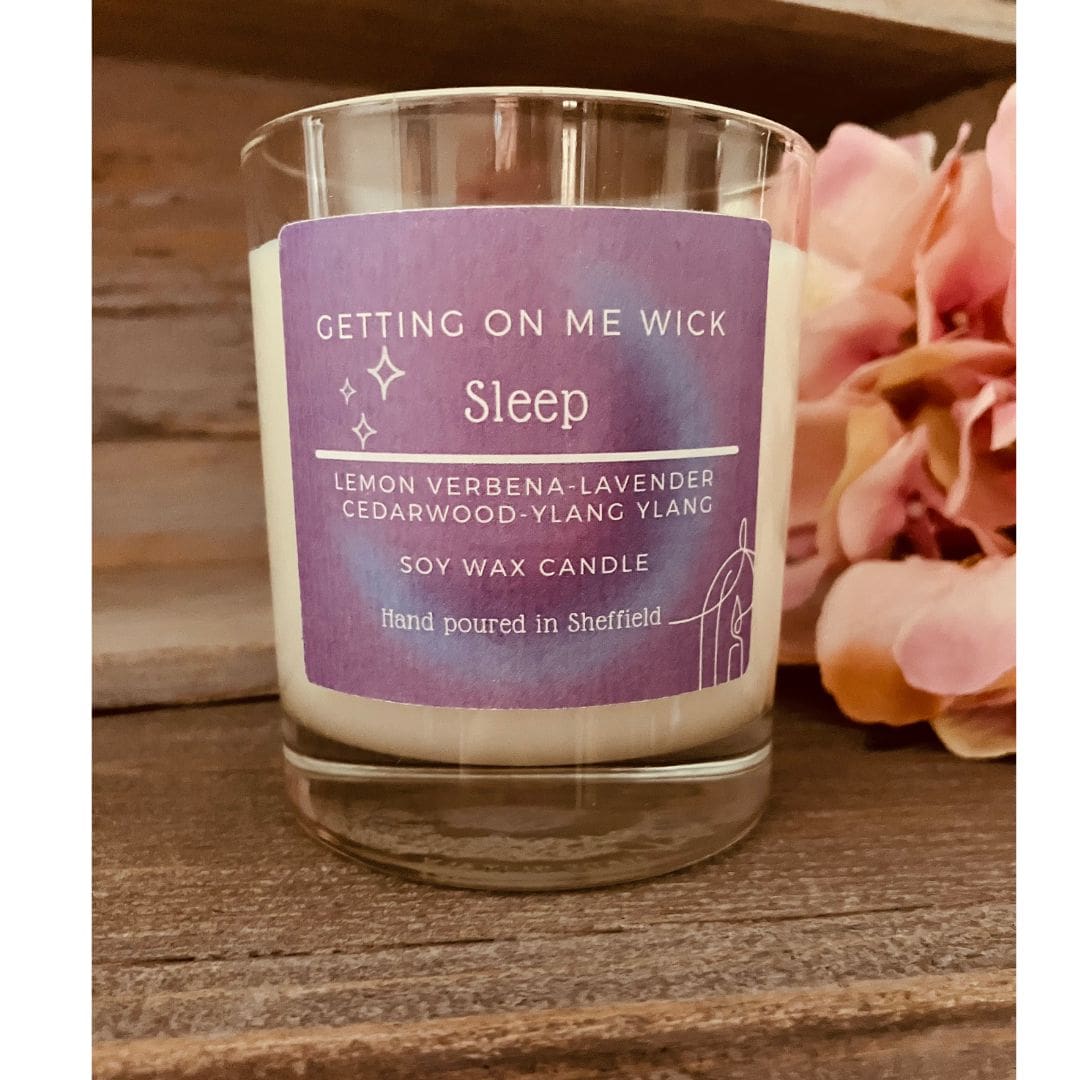
Discover the Serenity of Sleep with Our Organic Soy Wax Sleep Candle

In a world buzzing with activity and demands, finding solace in the tranquility of sleep can often feel like a distant dream. But what if I told you there’s a simple solution, elegantly packaged in the form of a sleep candle? Picture this: a flickering flame casting a soft glow, filling your space with the enchanting aroma of lemon verbena, lavender, cedarwood, and ylang ylang. This isn’t just any candle; it’s a sanctuary of serenity, meticulously crafted with organic soy wax and a blend of essential oils, each chosen for its remarkable ability to soothe the mind and body.


Let’s delve into the enticing benefits of these essential oils:

Lemon Verbena– Known for its refreshing and uplifting properties, lemon verbena stimulates the senses, promoting mental clarity and a positive mood. Its citrusy scent effortlessly sweeps away stress and tension, paving the way for a peaceful slumber.

Lavender- Ah, the timeless classic of relaxation. Lavender has been cherished for centuries for its calming effects, gently lulling you into a state of tranquility. Its sweet, floral aroma not only induces sleep but also enhances the quality of your rest, ensuring you wake up feeling refreshed and rejuvenated.

Cedarwood– With its woody, earthy fragrance, cedarwood grounds the mind, evoking a sense of stability and security. It’s like a comforting embrace, guiding you into a deeper state of relaxation and promoting a sense of inner peace that’s essential for a restful night’s sleep.

Ylang Ylang– The exotic allure of ylang ylang adds a touch of luxury to your sleep ritual. Renowned for its sedative properties, this floral essence helps to quieten the mind, easing feelings of anxiety and promoting a sense of serenity. It’s the perfect ingredient for unwinding after a long day.

Now, let’s talk about the steps you can take to maximize the benefits of your sleep candle:

1. Create a Relaxing Atmosphere: Set the scene for sleep by dimming the lights, playing soft music, and lighting your sleep candle. Allow its soothing aroma to fill the air, signaling to your mind and body that it’s time to unwind.

2. Practice Mindfulness: Take a few moments to engage in mindful breathing or meditation. Clearing your mind of racing thoughts will help you transition from the busyness of the day to a state of calmness and relaxation.

3. Establish a Bedtime Routine: Consistency is key when it comes to getting a good night’s sleep. Establish a bedtime routine that signals to your body that it’s time to wind down. Whether it’s reading a book, taking a warm bath, or practicing gentle stretches, find activities that help you relax and stick to them each night.

4. Limit Screen Time: The blue light emitted by screens can interfere with your body’s natural sleep-wake cycle, making it harder to fall asleep. Try to limit screen time at least an hour before bed and opt for more calming activities instead.

5. Create a Comfortable Sleep Environment: Make sure your bedroom is conducive to sleep by keeping it cool, dark, and quiet. Invest in a comfortable mattress and pillows that provide adequate support, allowing you to drift off into a deep and restful slumber.

Incorporating a Sleep candle into your bedtime routine is a simple yet powerful way to transform your sleep experience. Let its gentle glow and enchanting aroma guide you into a world of tranquility, where worries fade away and dreams take flight. Embrace the magic of a sleep candle and unlock the restful sleep you deserve. 

https://staging.thebritishcrafthouse.co.uk/product/sleep-candle/

* Remembering to burn your Sleep Candle always with care – never leave a burning candle unattended and always extinguish the flame before bedtime with a candle snuffer *

Posted on

A Conversation with Stained Glass Artist Joysofglass

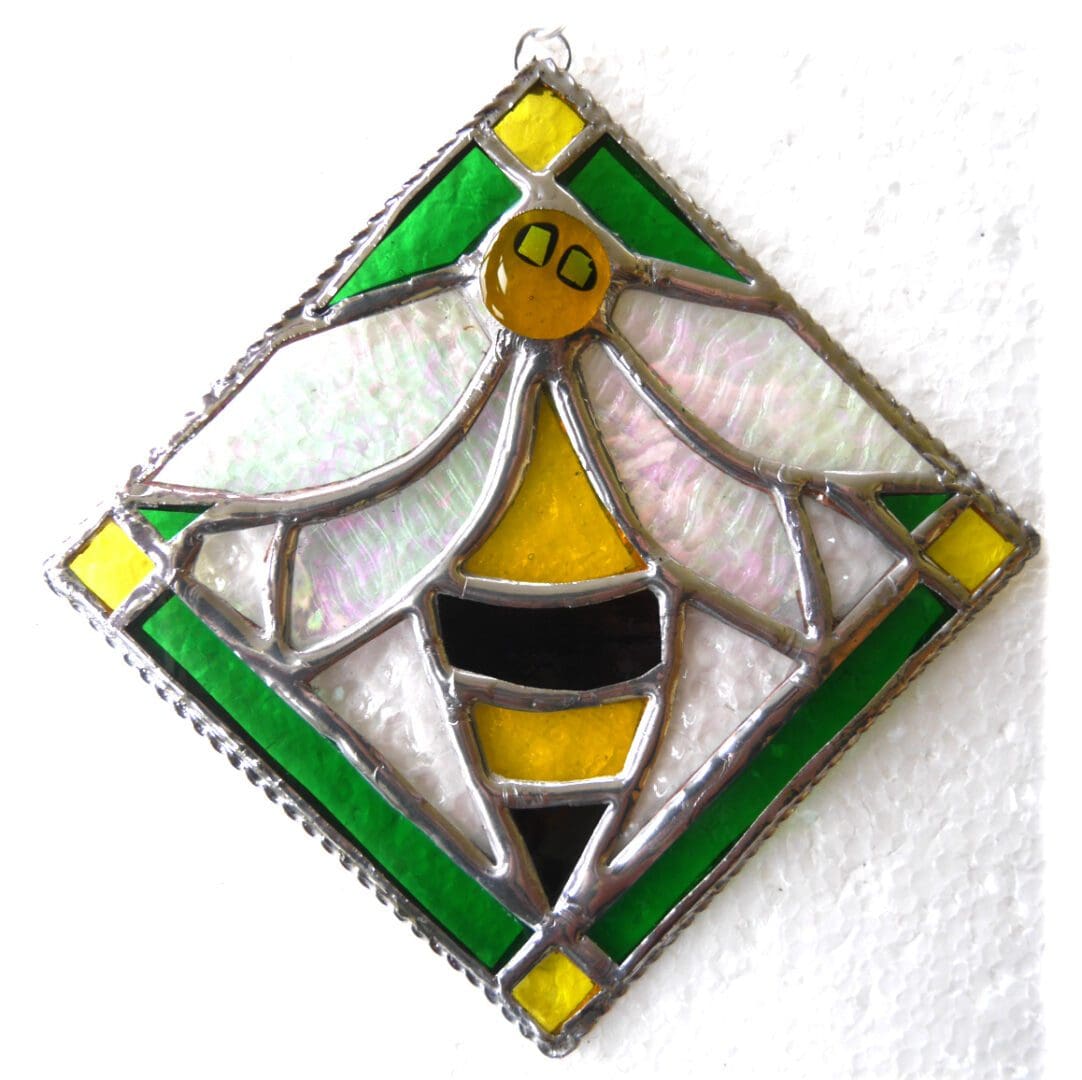
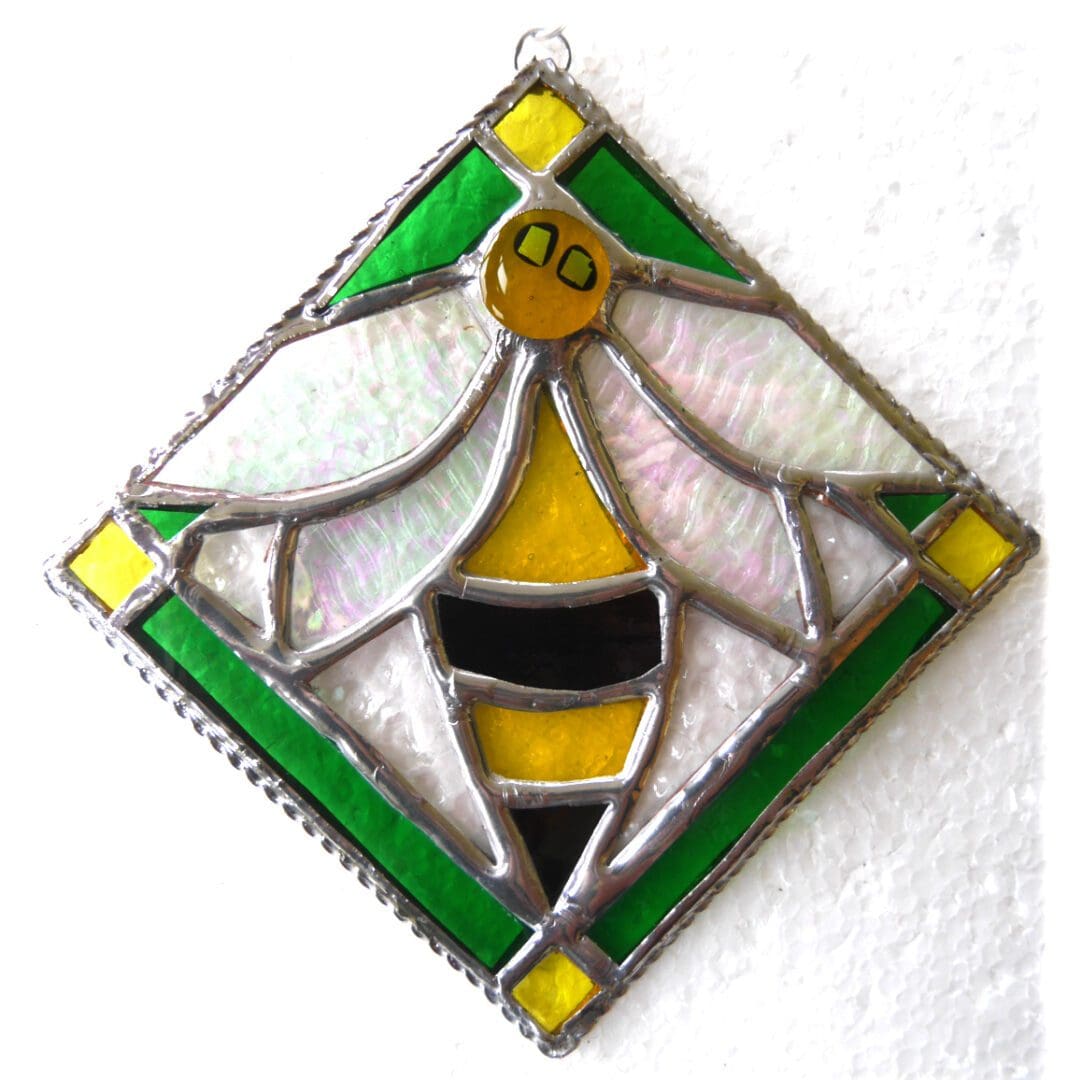
Bee stained glass suncatcher framed tile

Illuminating Creativity: A Conversation with Stained Glass Artist Joysofglass
Written by the lovely Louise of Sandgate Glass. 

https://staging.thebritishcrafthouse.co.uk/shop/sandgate-glass/

Unveiling the Magic Behind Breathtaking Stained Glass.

Hello and welcome to another blog post, for the next few weeks I will be interviewing my fellow sellers on The British Craft House

Today we have JOYSOFGLASS, an absolutely fabulous stained glass artist. Her art work always makes me smile, it is so bright and cheerful! I am in awe of her cutting skills!. Enjoy!

Tell us a little bit about yourself and your business.  

I’m a Glass Artist. I mainly do Stained Glass but Tiffany Copper Foiled Suncatchers rather than the Leaded windows I started with.  I’ve been glassing since I did a course in Leaded stained glass in early 2008 and selling on line since 2009.

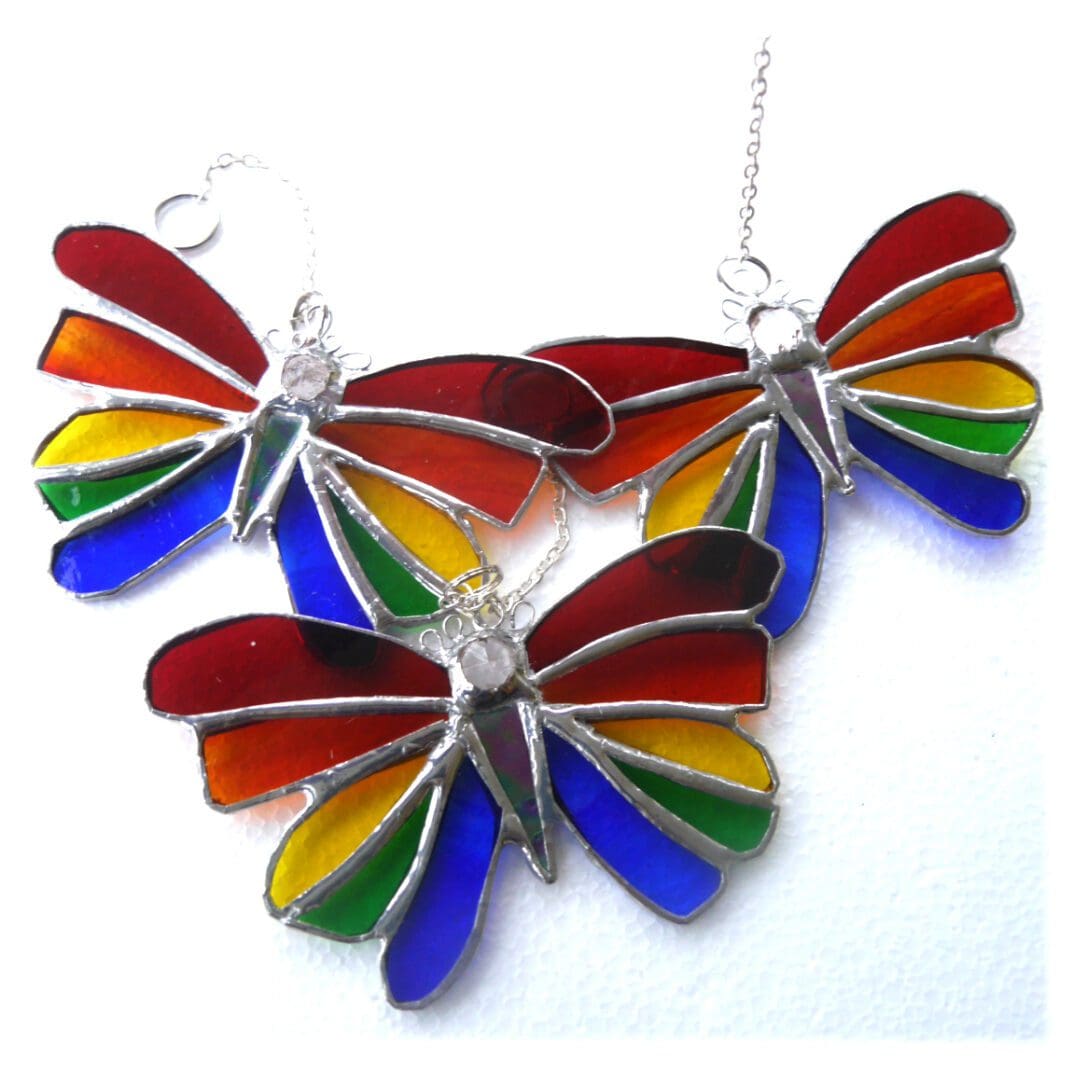
rainbow coloured suncatcher butterflies

What initially drew you to the art of stained glass?

I was in my church choir from age 9 until I left town to go to University and then work in IT in London. The church had a superb Altar window. I sat underneath it 3 times a week for years and must have got into my blood as when I was offered  a 3 day course of anything I fancied in 2008, by my WI,  I chose stained glass.

Can you walk us through the process of creating a stained glass piece, from initial concept to finished product?

I draw my design on paper using the computer to draw circles and rectangles as the computer does those better than me. I do a lot of tracing to keep within the frames the computer draws. When I have my pattern I scan it into the computer and can then print it multiple times whenever I want to make it again. I need 2 patterns per piece as one gets wet in the process.
I choose my glass and cut all the pieces. Then I grind all the edges of each piece, they have to be smooth and the grinder can also make sure things fit together well. Then wash everything to get the ‘grind’ off before  copper foiling. This is a thin copper tape, normally 7/32 inch wide, which is self-adhesive. I wrap it round the edges of each piece, use a fidd to burnish all over the copper so it adheres well. Then I put all the pieces back on the paper pattern like a jigsaw (the dry one as the first gets too wet when I grind), switch the soldering iron, brush the glass all over with liquid flux and  solder it all together . Back, front and all round the edge to cover all the copper tape. Last stage is to attach hanging rings, a good wash in soapy Fairy water before attaching a hanging chain and a thorough polish with carnauba wax car polish. All that is left is to photograph, list it in my shop and sell it.

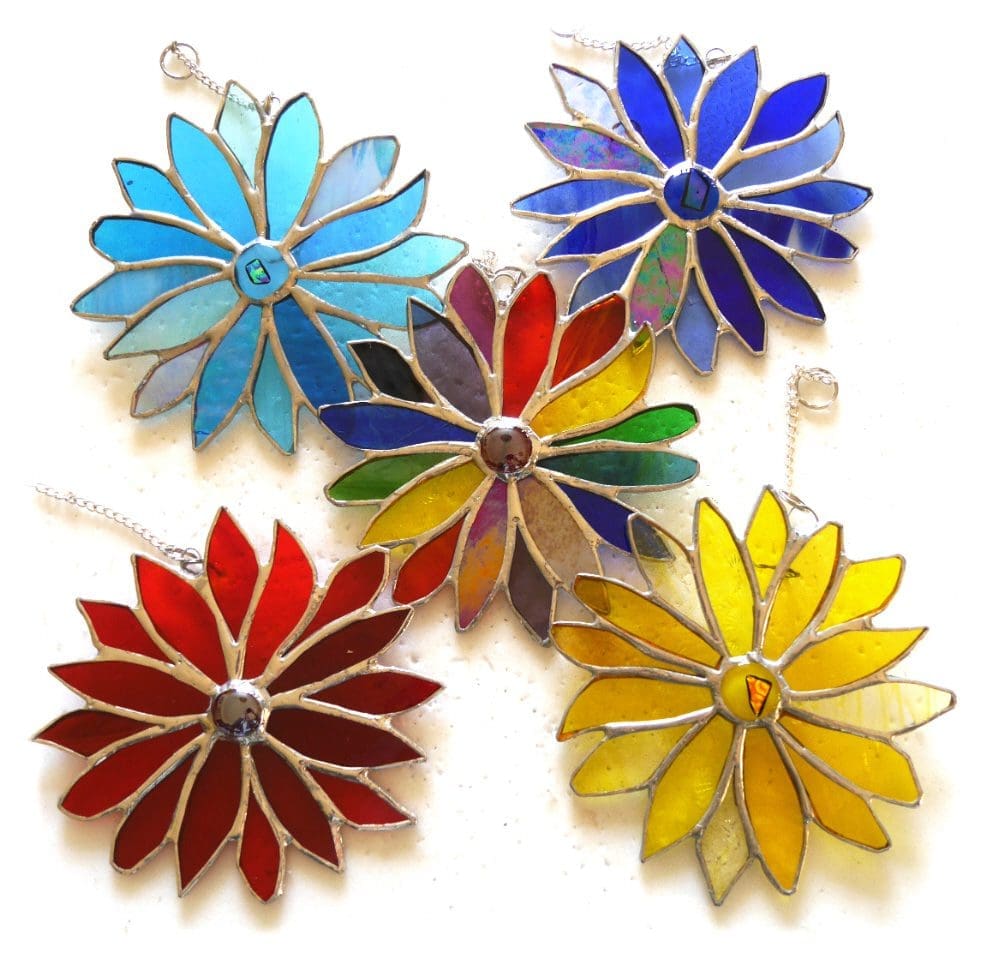
rainbow stained glass catcher

Where do you find inspiration for your designs?

Anywhere really. I see things when I am out and about or spot something on the internet, think about it for a while until my head works out what it wants to do with the idea and how to translate into a cutable glass design.

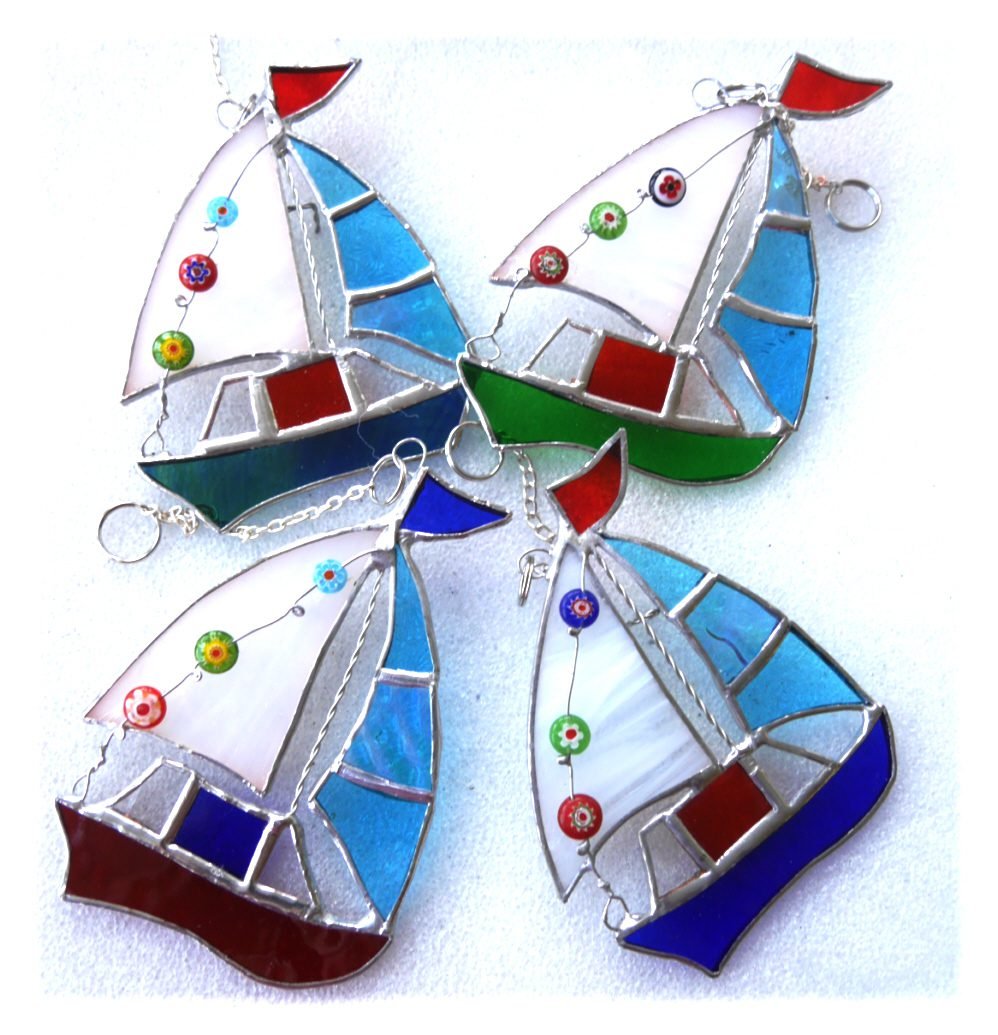
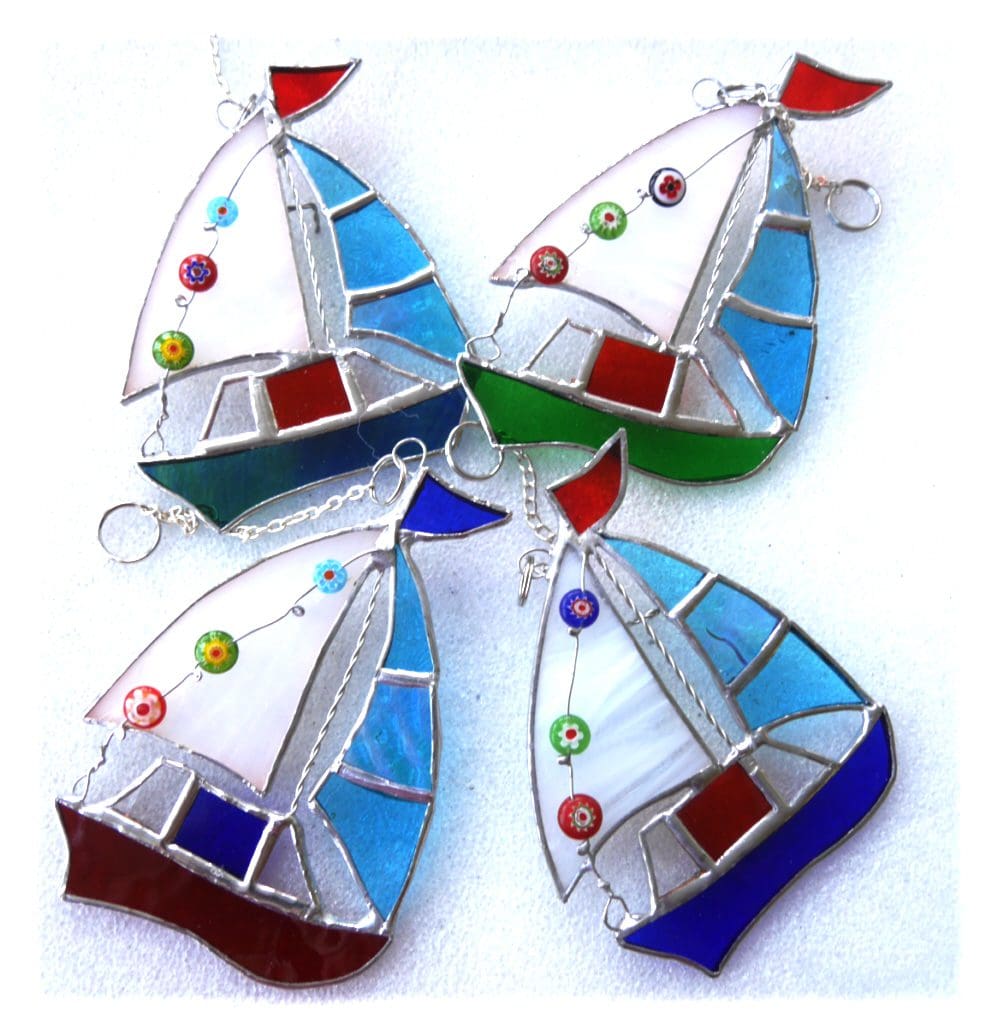
Blue sailboat stained glass suncatcher red flag

What are some of the biggest challenges you face as a stained glass artist?

My fingers can get a bit sore and I can’t copper foil wearing plasters on them so have to be very careful not to make them bleed  I wear gloves, gardening ones actually and always have since I started. I rarely handle any glass without gloves on. I am on blood thinners so if I stick a bit of glass in the end of my finger (favourite way to cut myself) I have to wait at least  half an hour before I can use my finger again.  My grinder top is full of water and in winter as I work in an unheated garage I have to it with water from the kettle as cold water really makes them sore.

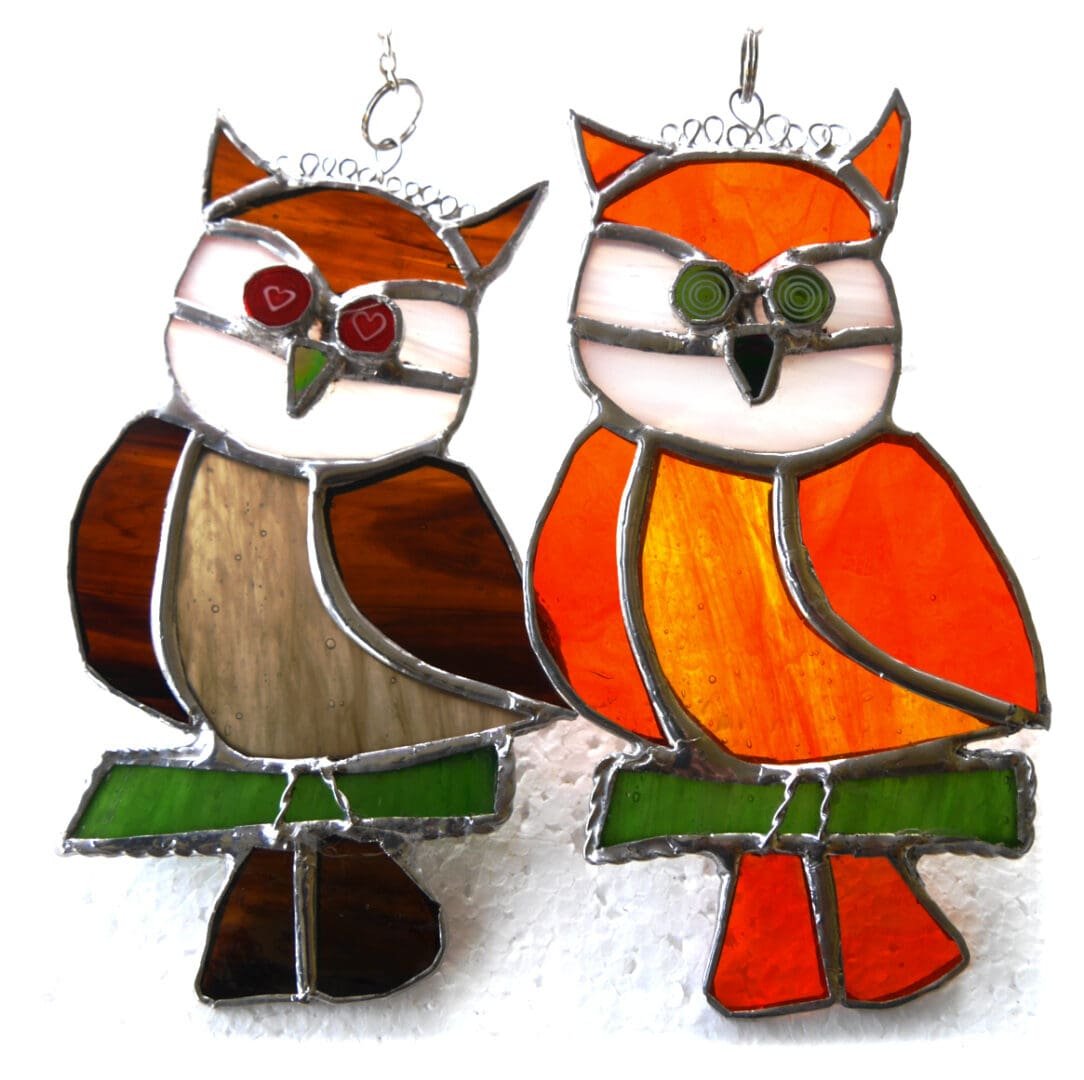
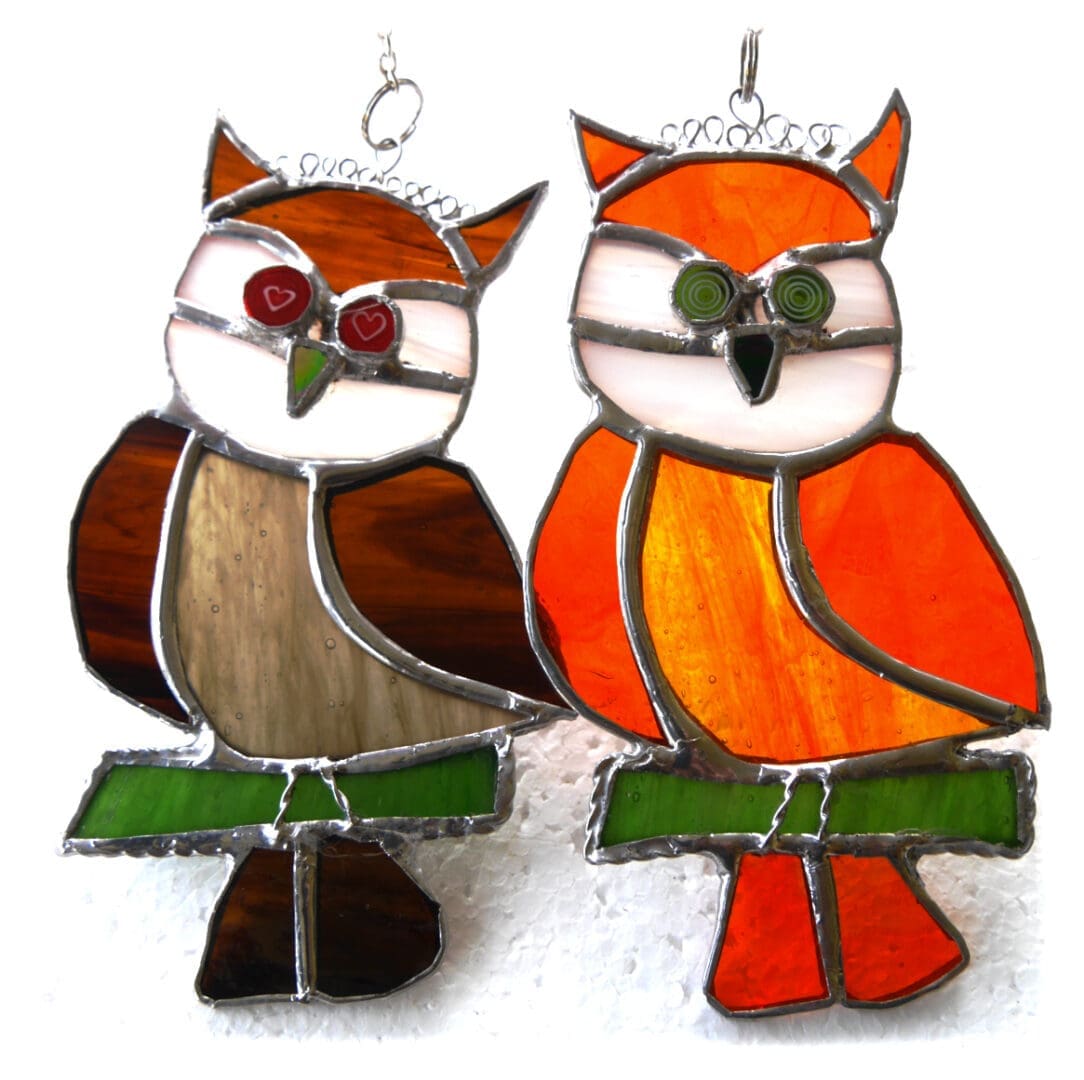
stained glass hanging owls

 How do you ensure the quality and longevity of your stained glass pieces?

I examine each piece as I make it and check for weak points and correct them to strengthen as well as I can.  I use twisted glass as a frame round bigger pieces. Glass is likely to break when dropped but if it has wire round it is far less likely to fall to pieces. My daughter has a water lily which I designed for her. It has a little internal crack I have noticed but it is still absolutely fine. Thank goodness for the twisted wire frame.  As I polish I examine everything holding it up to the light to make sure there are no rough bits, usually found if the duster catches them. I never switch the soldering iron off until I’ve finished polishing in case I need to do any touch up to the soldering.


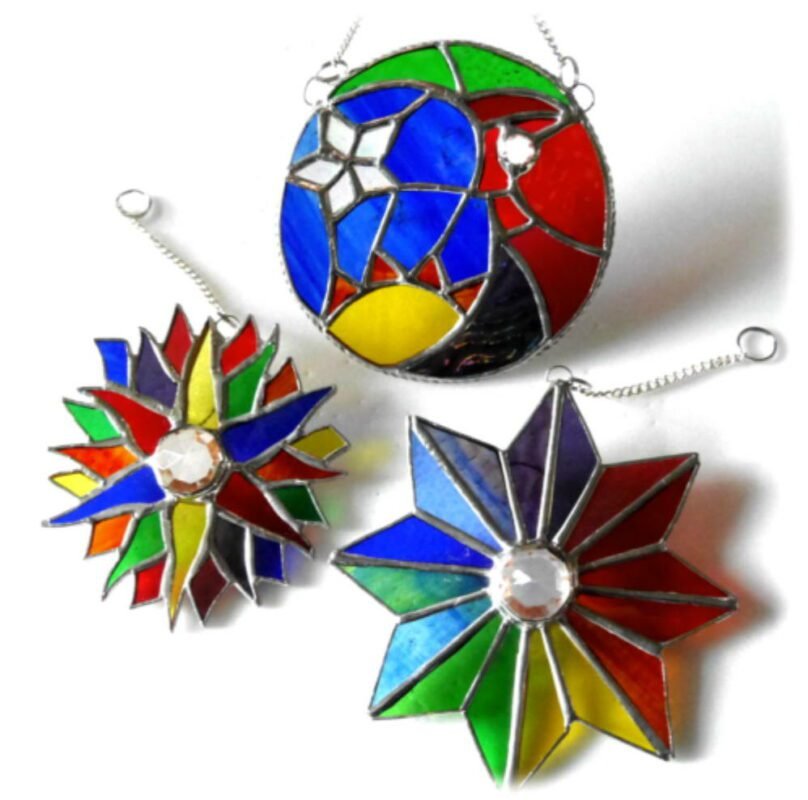
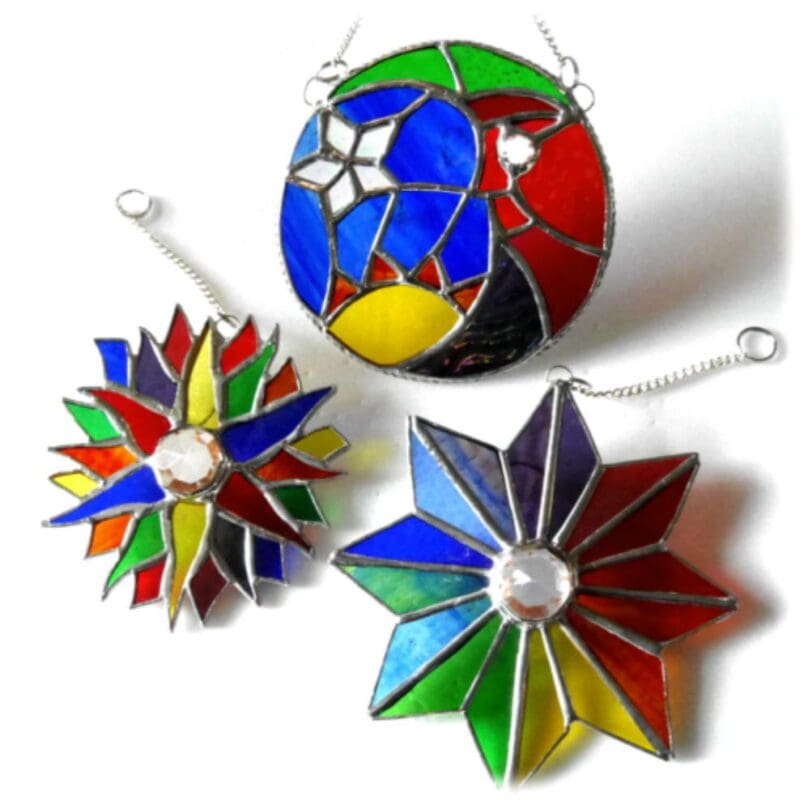
sun moon and stars stained glass suncatcher

What are some of the biggest challenges you face as a seller?

Getting my work out there. Such a big wide world but social media is fickle and sometimes spreads my posts well and at other times it hides me.

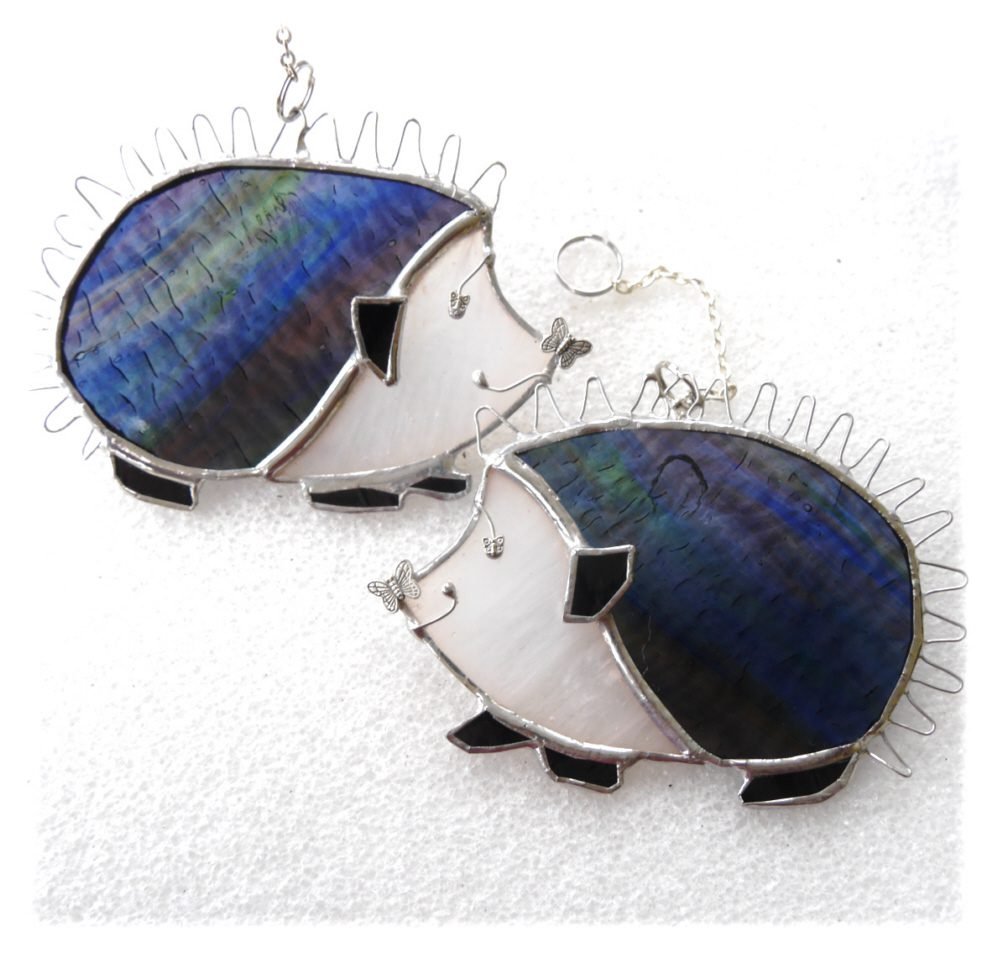
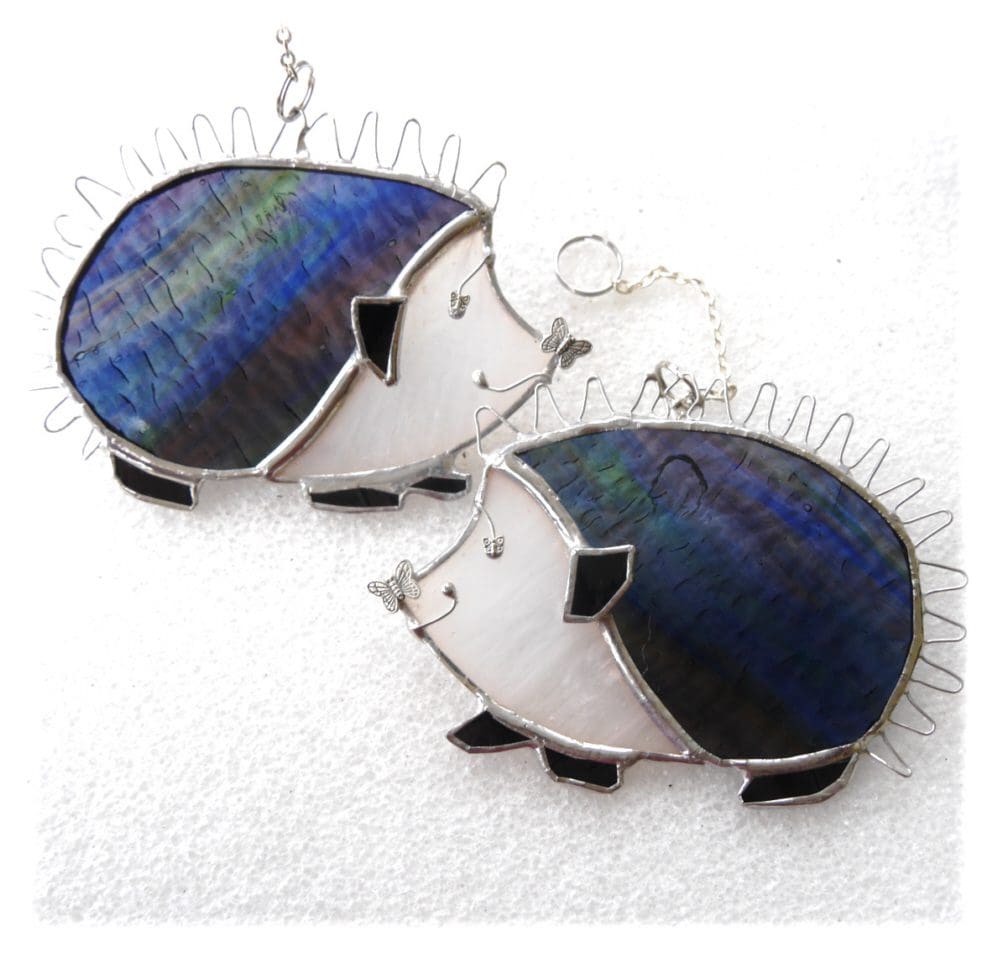
hanging hedgehog stained glass suncatcher

Can you describe a typical day or week in your life?

I glass most days I am at home even if only for a few hours. I am officially retired (used to be in IT) so don’t get up early but I do go to bed very late. Currently 00.27  according to my laptop..  I usually print off the patterns I am going to make that day and head for the garage.  Then back to the house after cutting and grinding as I copper foil in the living room and solder in the porch (warmer and good light). 
If It’s sunny I might pop into the garden for an hour or so to tidy the garden but otherwise I just occupy myself, very happily, doing what I love, glassing.
Hopefully later in the afternoon if I have orders from the previous day or earlier that day I pop out to the local post office to catch the 4.15pm collection.

multi coloured hanging suncatcher

Do you offer custom stained glass commissions? If so, how can potential customers get in touch with you?

If someone wants me to make something then I will always happily consider it. Customers contact me via my Facebook or Instagram account or by email as either a returning customer or from my contact page on my own Joysofglass website. I don’t sell from there, no need to as I have good shopping platforms to use which are already set up for that but I do use my website as a shop front to direct to my actual online shops.  My British Crafthouse shop is of course my favourite and I actually have two. One full of stained glass, the other fused as I have too many listings for just one shop.

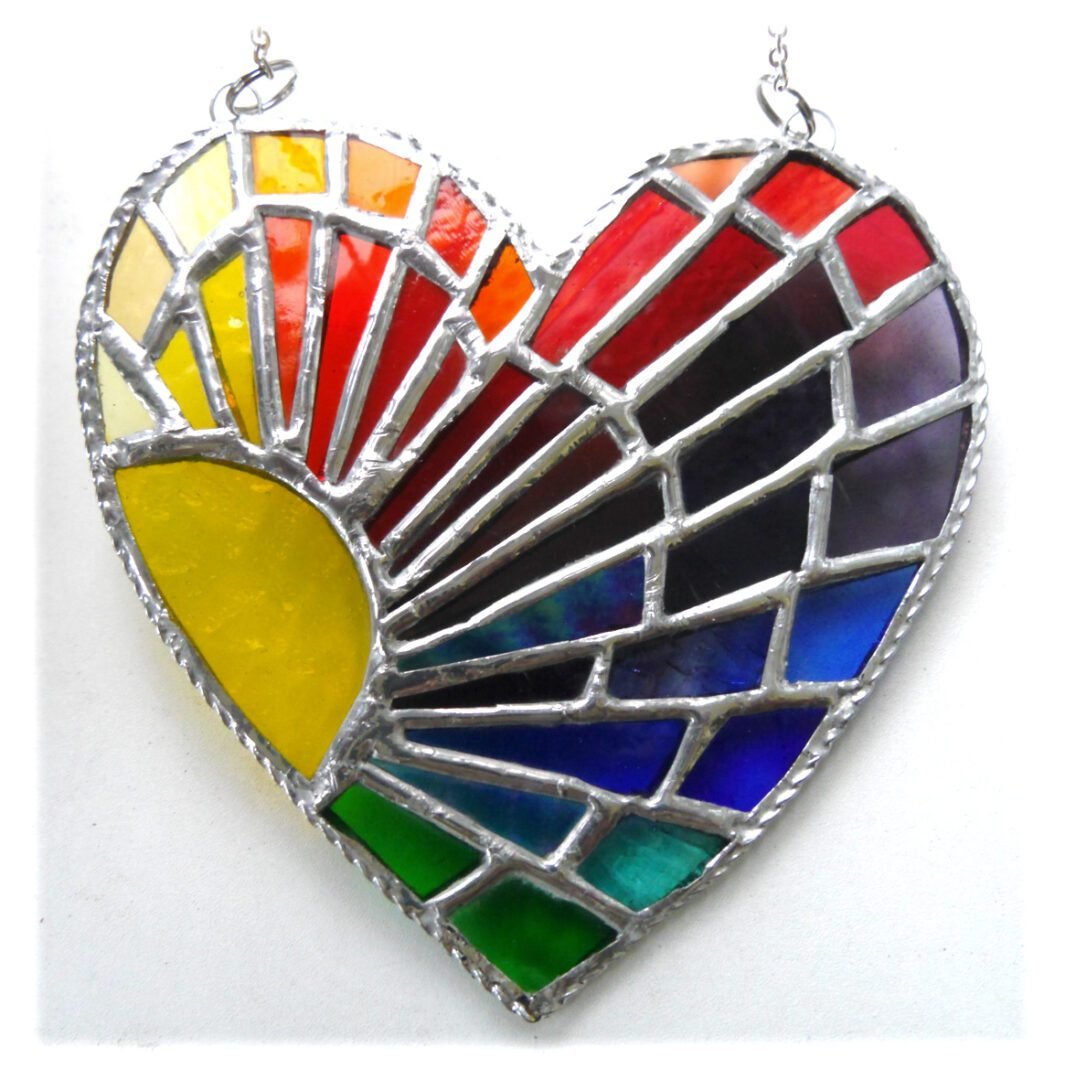
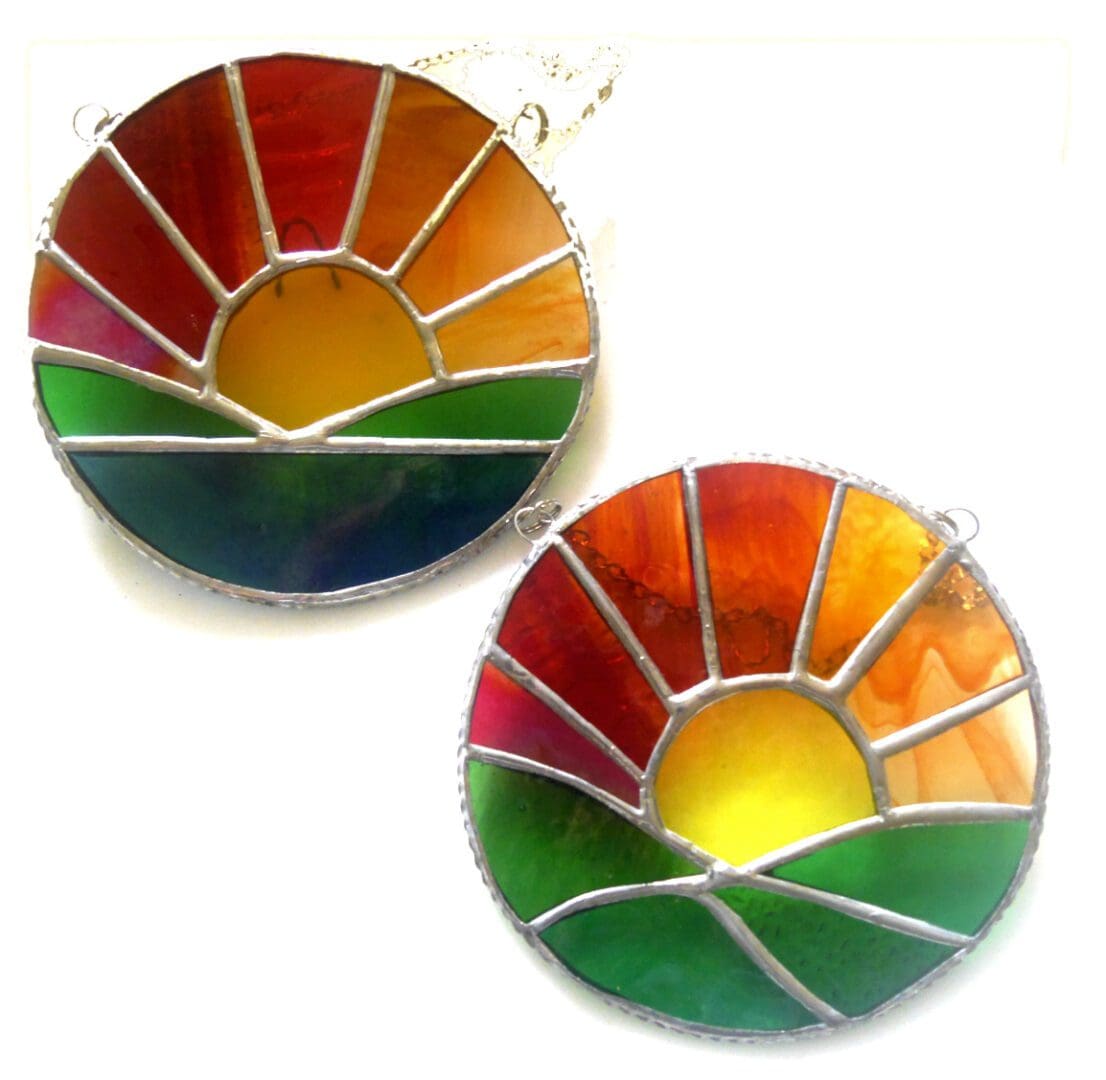
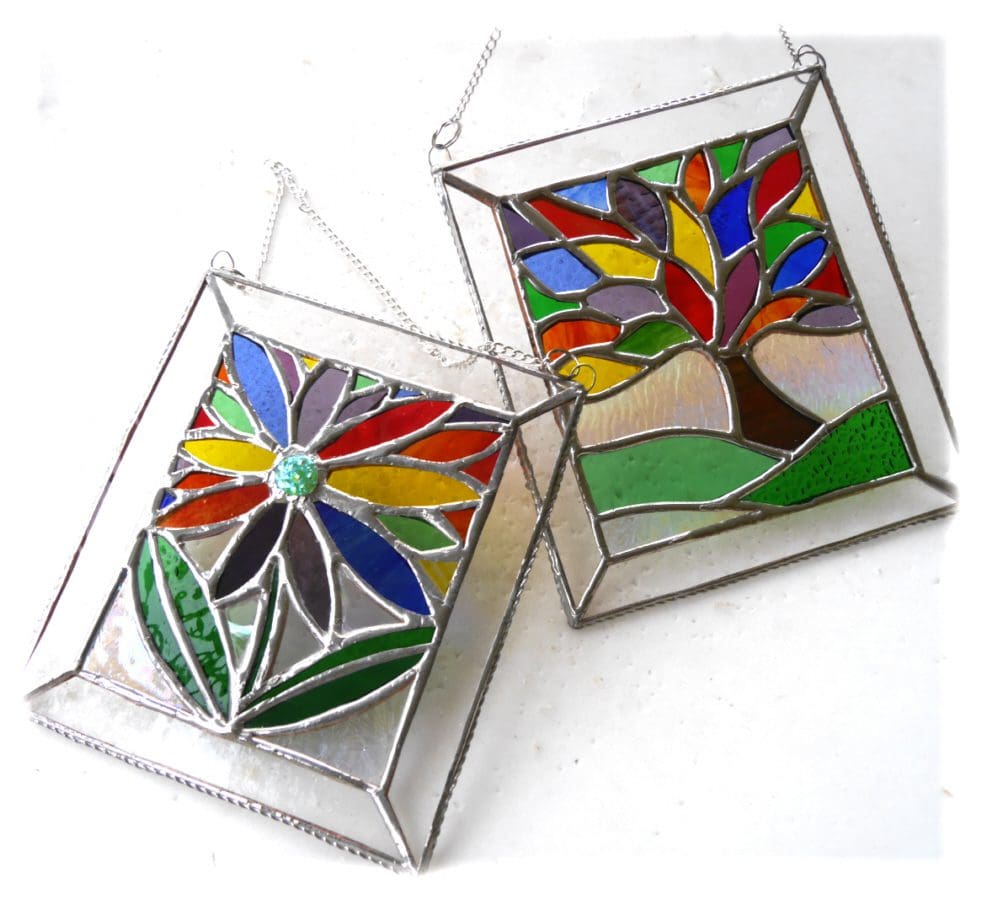
stained glass sun and fields
stained glass beach huts

What has been your most rewarding experience as a stained glass artist?

My very best experience was only last month when I was presented by Theo Paphitis with my SBS award. The whole experience of the event was epic
.
Otherwise I get rewarding experiences most days with lovely emails from my customers and super reviews. Makes every little cut of my fingers worthwhile.


rain bow tree of life stained glass

Have you ever had a particularly unique or challenging stained glass commission?

Bob my husband decided we needed to replace the door from the kitchen to the porch to let in more light. So he said I will make the door and you can make the window (2 long thin panes required and leaded not copper foiled).  I did it but it was a challenge. My glass bench is not set up for large pieces, not as big as those two window panes anyway and I had to work wherever I could  find space in our already messily full garage.  Really love it though and it is so good to have something we both made which we see all day every day.

What makes your products unique and stand out from others?

Over time I have of course become more and better skilled and I do pay extreme attention to detail. I have a very wide range of designs now, a massive selection of all types and shades of glass and I hope my enjoyment in creating comes through in my work. I sometimes feel guilty that with so many of my own designs it must be hard for other glass artist so design something which is not a copy of one of mine. But I don’t feel too bad about it. 

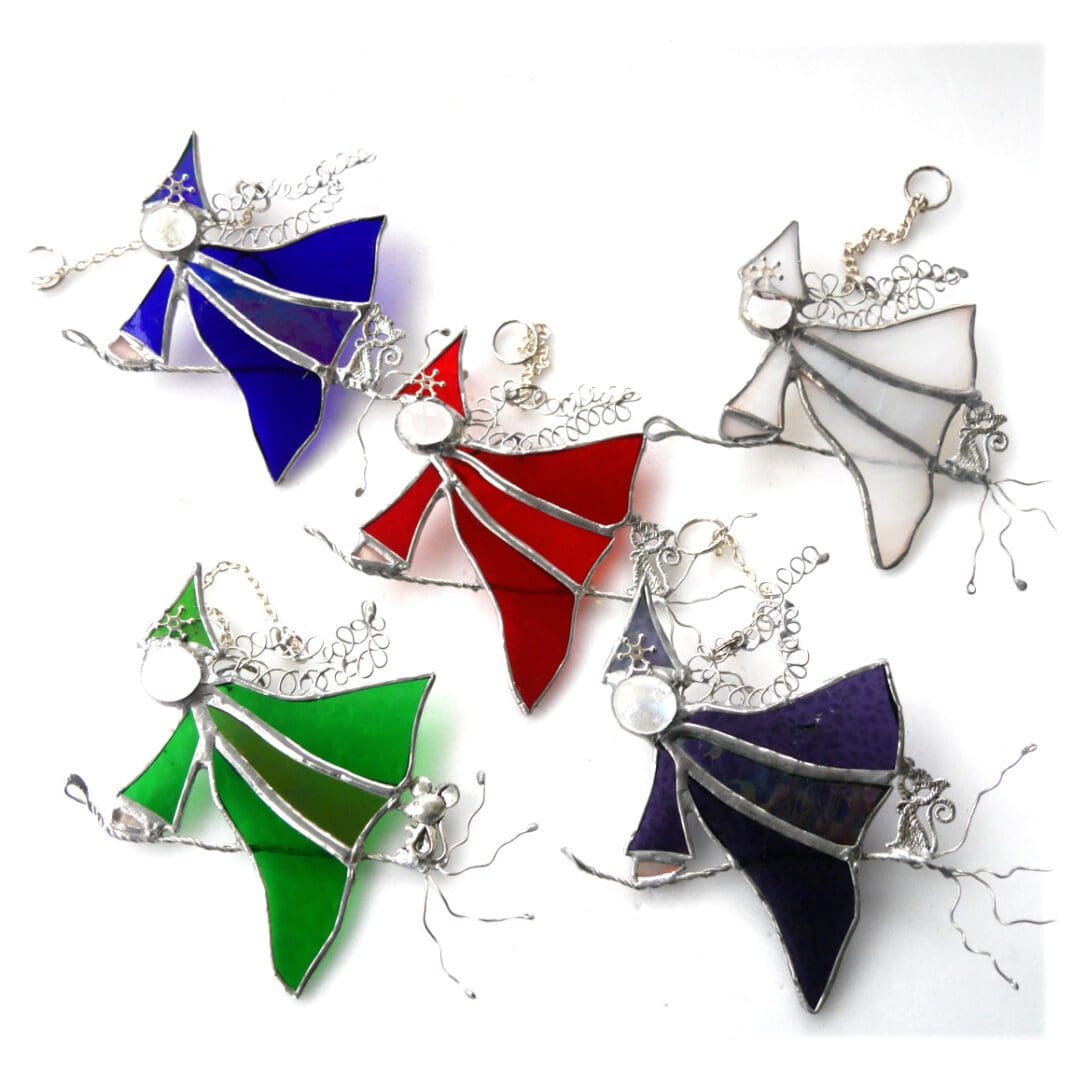
multicolour stained glass flying witches

What are some future goals you have for your craft business?

More of the same. I cannot expand my ‘operations’ as I am constrained by my house and I am perfectly happy making as much glass as I can sell while also doing the other things we do such as quite a lot of holidaying and travelling.

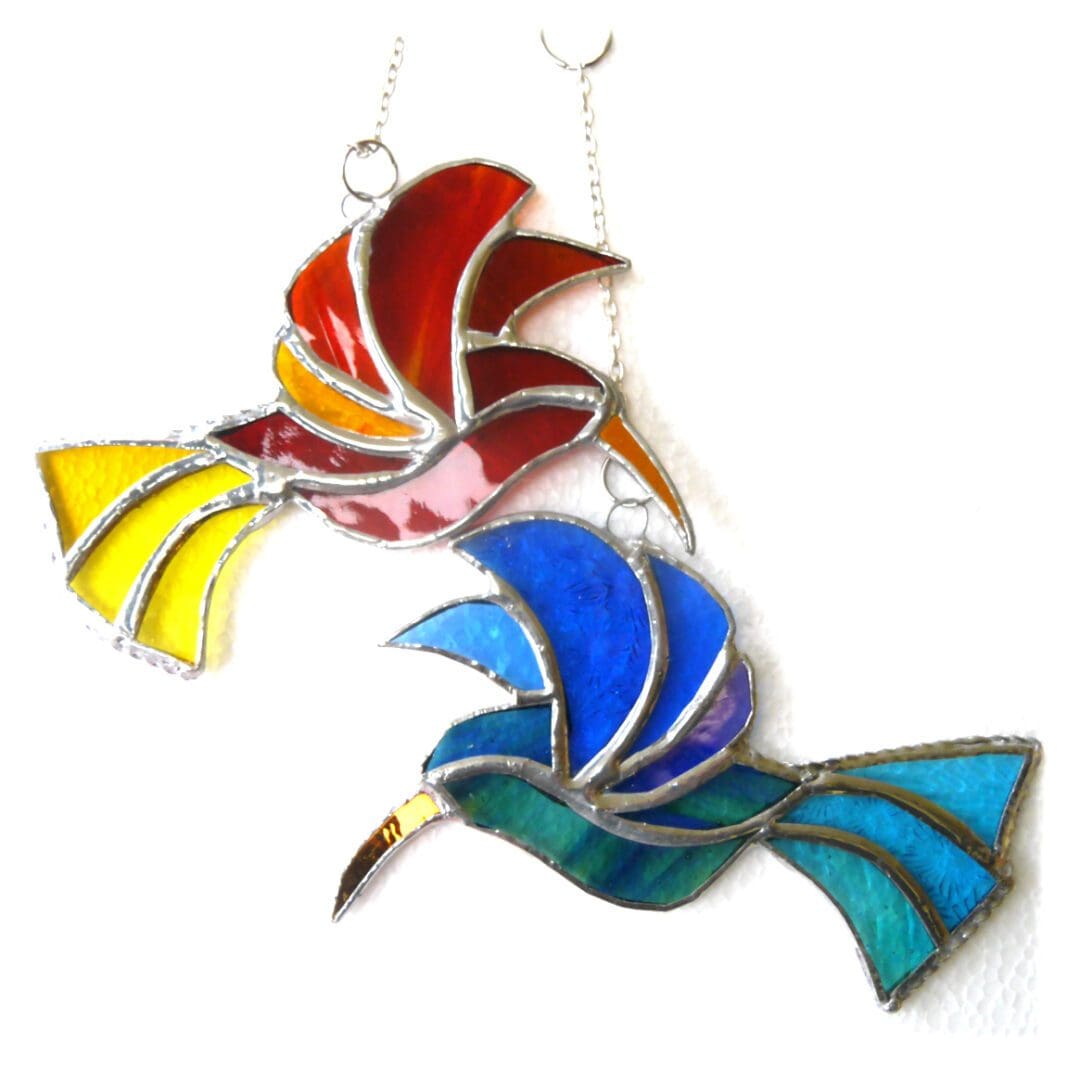
multicoloured hanging humming bird stained glass suncatcher

What is your favourite listing on your TBCH shop?  

Sorry I don’t have one. I have such a lot of designs and often they are also in different colours and I really do like most of them. My Hare is my current favourite but that is because I love hares and this design is very new. February and I’ve already sold 4. It is out of stock at this moment. I made another yesterday but sold it right away.  That’s my job for Sunday, make a 5th..

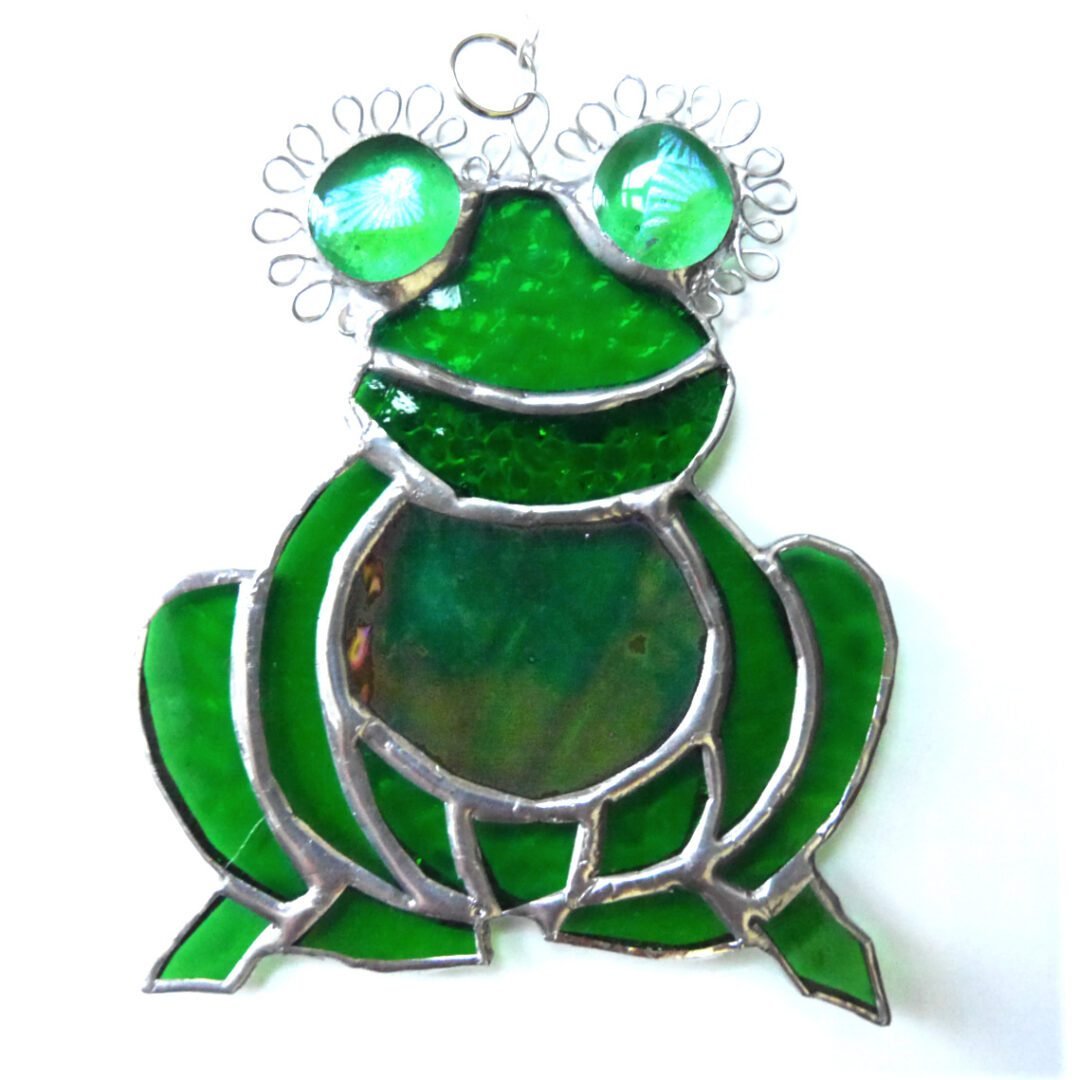
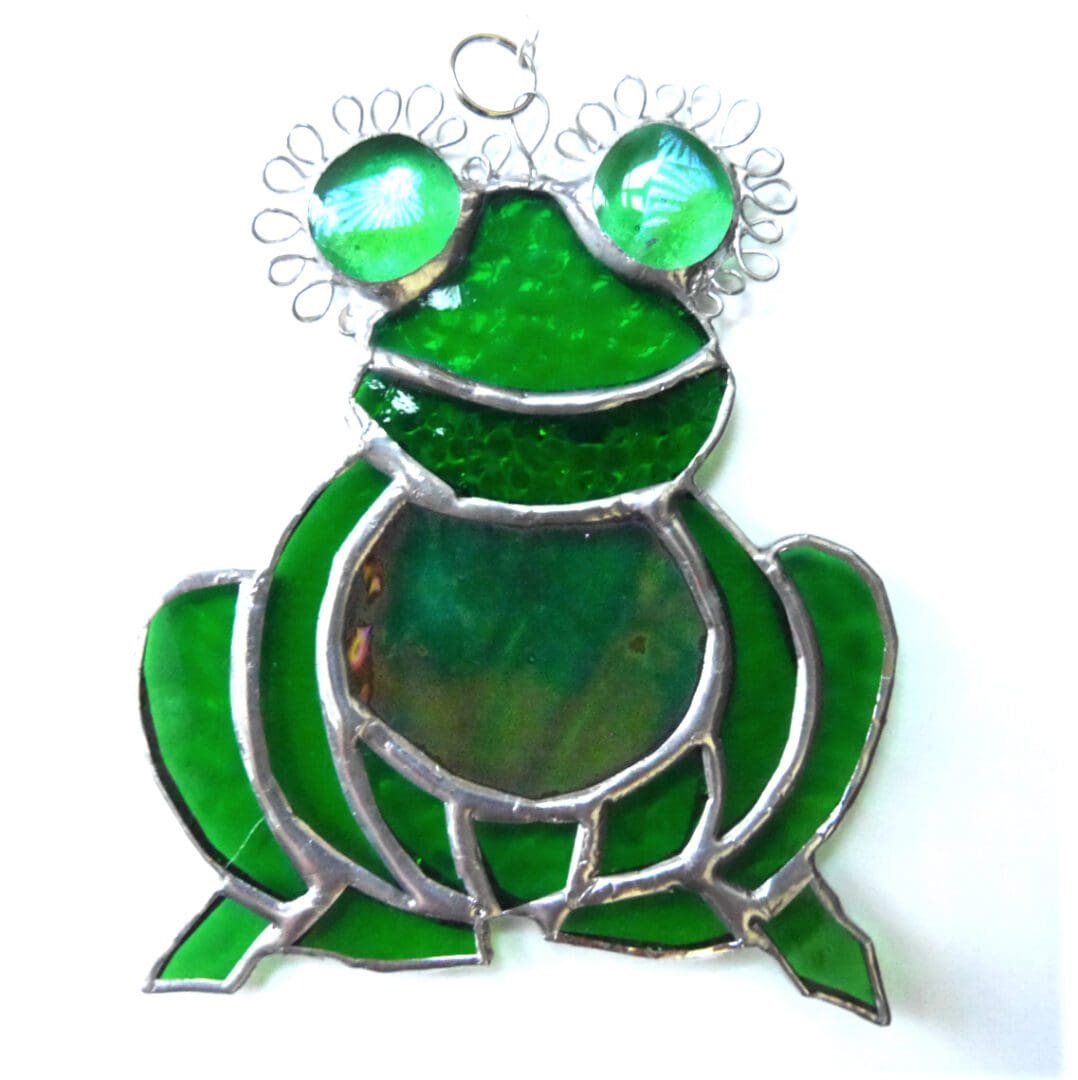
green frog hanging stained glass suncatcher

What piece of advice would you give to your younger self?

Have more confidence in yourself. Don’t wait so long to get that confidence. You can do whatever you want. Just get out there and do it.

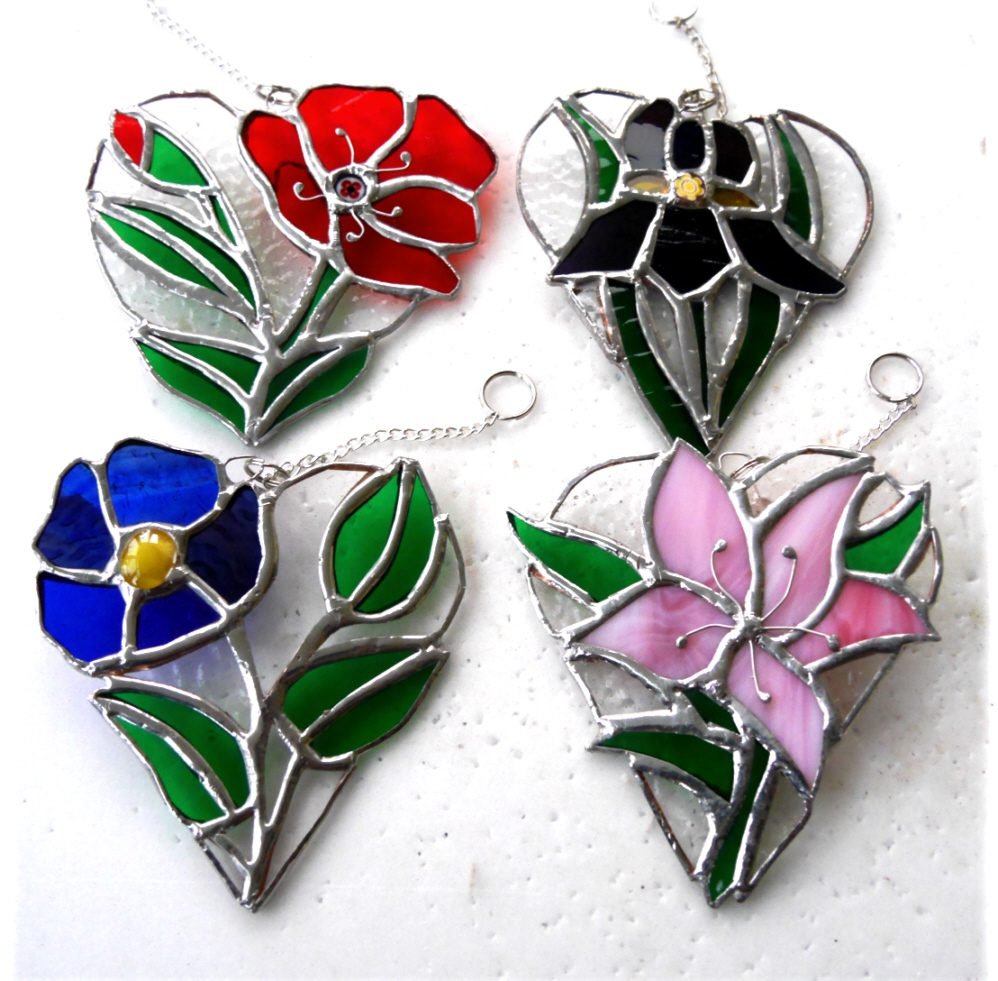
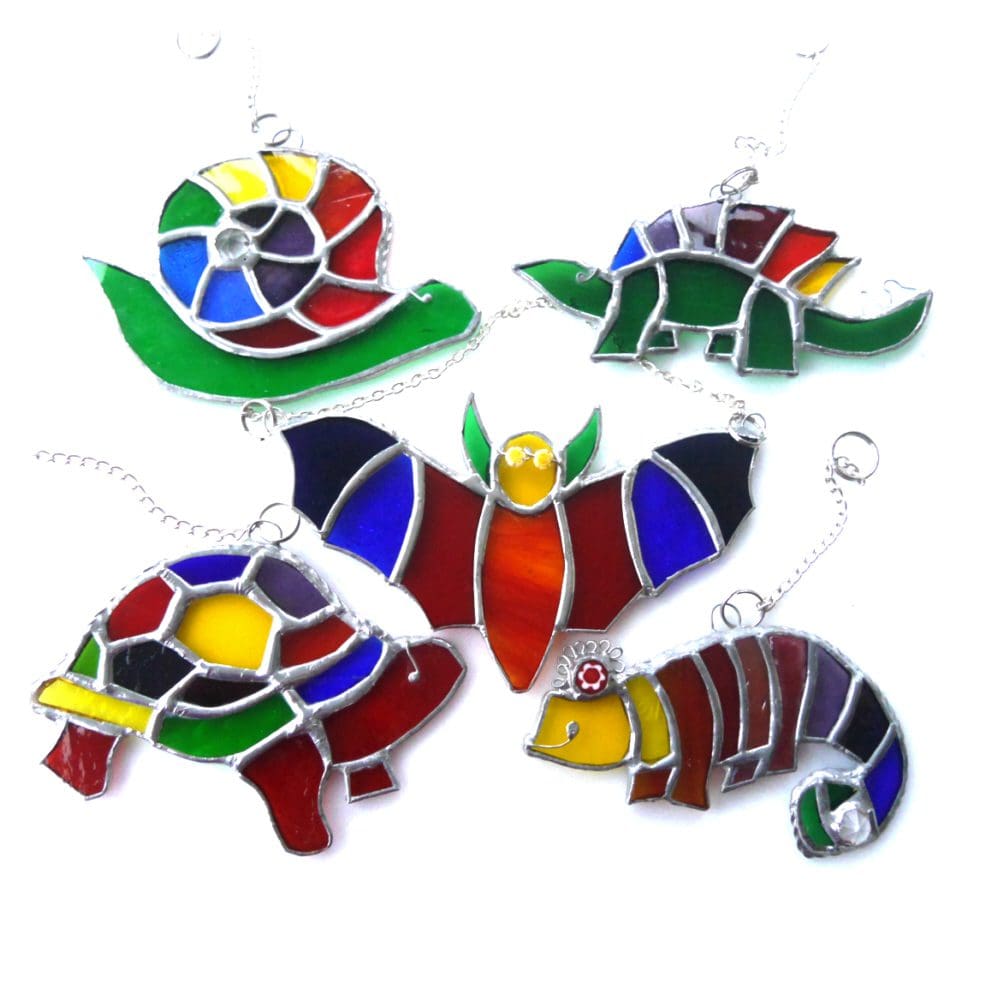
stained glass hanging stained glass suncatchers

 What hobbies do you like to do? How do you relax?

My camera lives round my neck when we are out and about. So I take photos but my favourite way to take photos is when we are away somewhere. Have a few days in Derbyshire planned shortly. Then Cyprus for a week in April. June will be France with the caravan and September hopefully Italy.
 

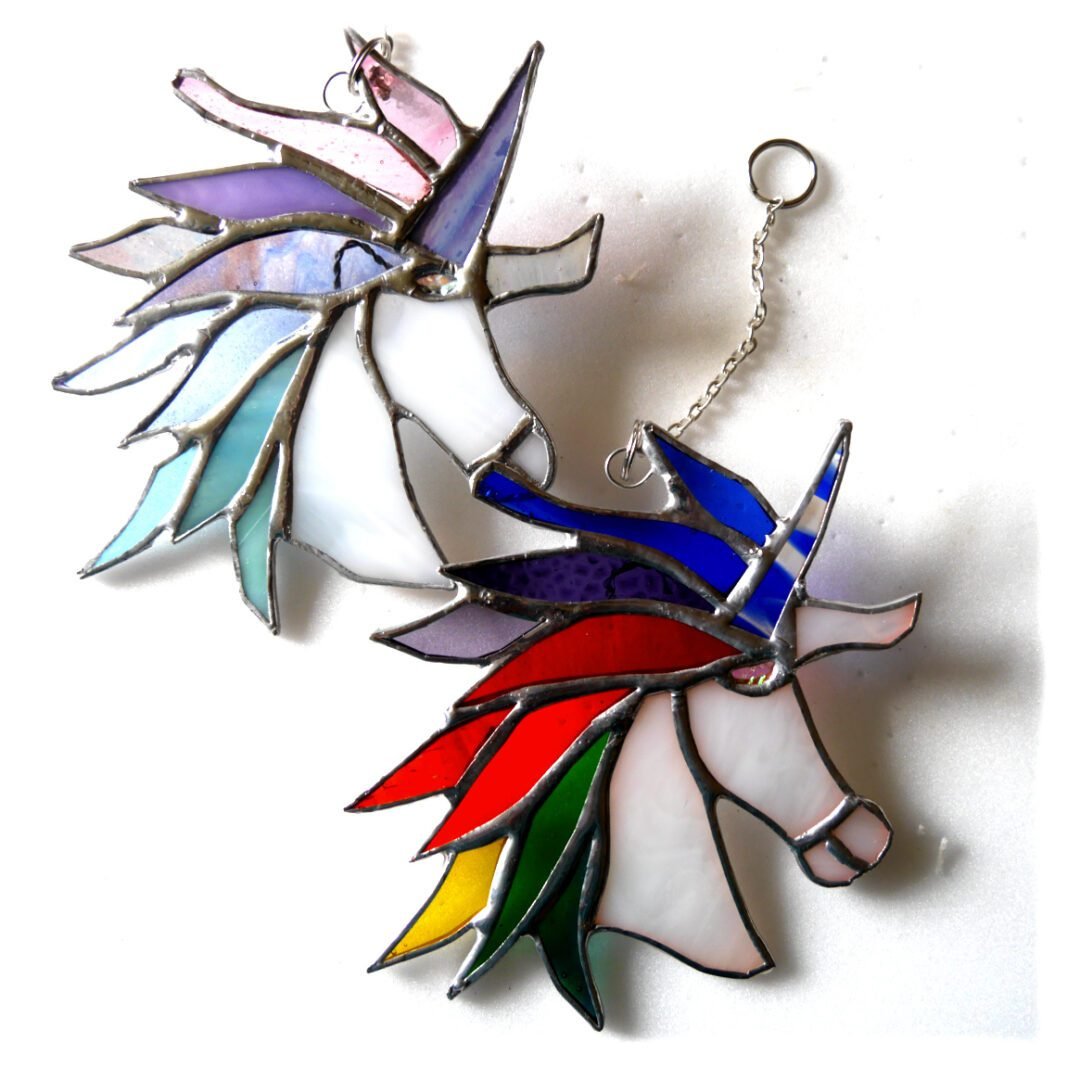
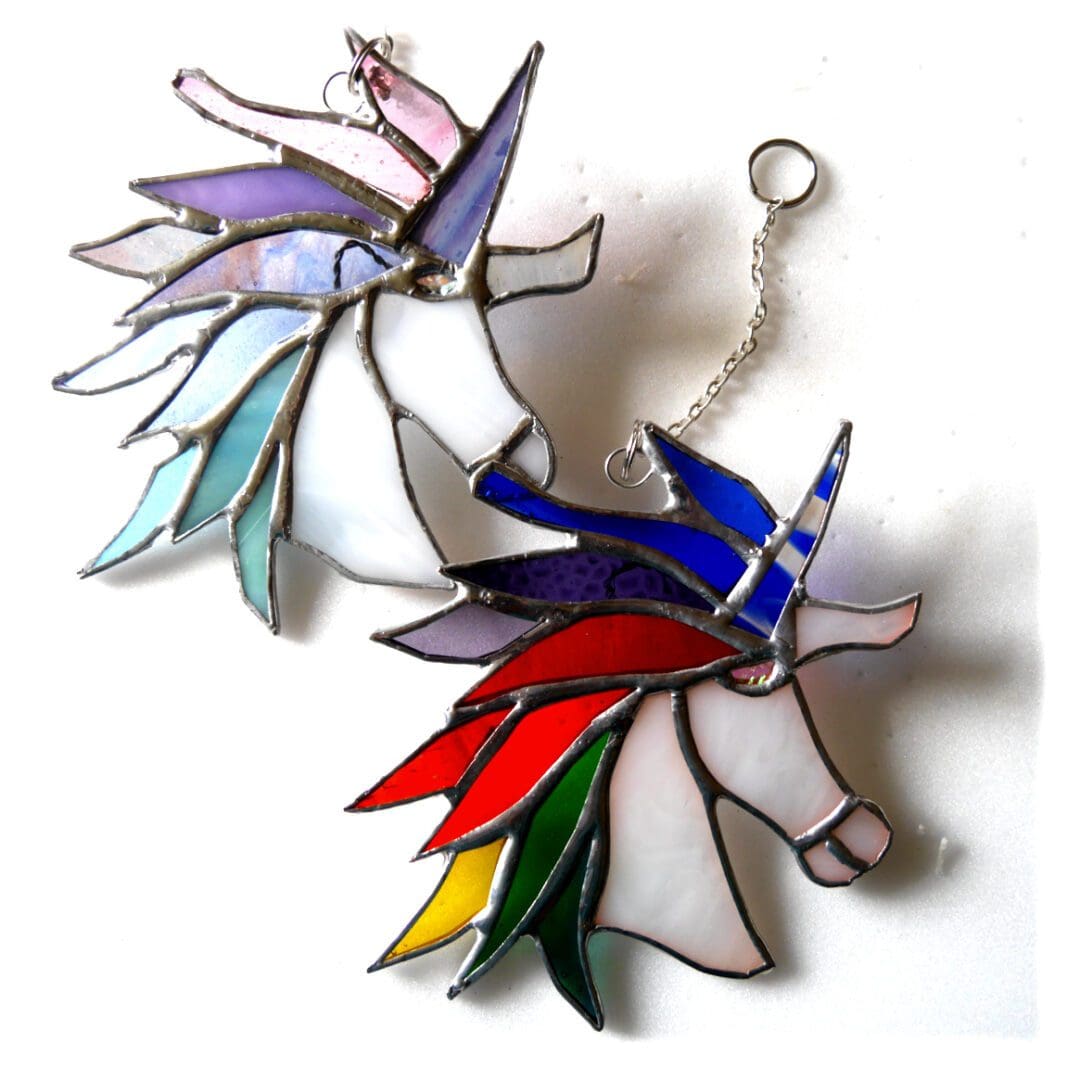
unicorn stained glass

Tell me a strange or unusual fact about yourself/ any claim to fame?  

I sing. I sang as a child .. age 3 was first time on stage I believe singing “me and my teddy”. I was quite a good singer. I took A level music ( a long long time ago)  with my voice as my instrument. Sadly smoking lost a couple of octaves for a while but having stopped that  in 2006 I am now mostly recovered and I Always sing when working, in  the garage, in the garden, in the house. And if I have a cold and therefore a croak I am really rather good at whistling. I have perfect pitch so that helps for tunes but I can also do a four finger really really loud one if pressed. My daughters will bear witness to that as I had to use it sometimes if I lost them when we were out .

train tractor bus hanging stained glass suncatcher


Is there anything else you would like to share with our readers?

My motto is My name is Joy and Glass is my Joy..   and it is !

https://staging.thebritishcrafthouse.co.uk/shop/joysofglass

Posted on

Illuminating Creativity: A Conversation with Stained Glass Artist Joysofglass

Unveiling the Magic Behind Breath taking Stained Glass.

Hello and welcome to another blog post, for the next few weeks I will be interviewing my fellow sellers on The British Craft House

Today we have JOYSOFGLASS, an absolutely fabulous stained glass artist. Her art work always makes me smile, it is so bright and cheerful! I am in awe of her cutting skills!  Enjoy!

Tell us a little bit about yourself and your business.  

I’m a Glass Artist. I mainly do Stained Glass but Tiffany Copper Foiled Suncatchers rather than the Leaded windows I started with.  I’ve been glassing since I did a course in Leaded stained glass in early 2008 and selling on line since 2009.

What initially drew you to the art of stained glass?

I was in my church choir from age 9 until I left town to go to University and then work in IT in London. The church had a superb Altar window. I sat underneath it 3 times a week for years and must have got into my blood as when I was offered  a 3 day course of anything I fancied in 2008, by my WI,  I chose stained glass.

Can you walk us through the process of creating a stained glass piece, from initial concept to finished product?

I draw my design on paper using the computer to draw circles and rectangles as the computer does those better than me. I do a lot of tracing to keep within the frames the computer draws. When I have my pattern I scan it into the computer and can then print it multiple times whenever I want to make it again. I need 2 patterns per piece as one gets wet in the process.
I choose my glass and cut all the pieces. Then I grind all the edges of each piece, they have to be smooth and the grinder can also make sure things fit together well. Then wash everything to get the ‘grind’ off before  copper foiling. This is a thin copper tape, normally 7/32 inch wide, which is self-adhesive. I wrap it round the edges of each piece, use a fidd to burnish all over the copper so it adheres well. Then I put all the pieces back on the paper pattern like a jigsaw (the dry one as the first gets too wet when I grind), switch the soldering iron, brush the glass all over with liquid flux and  solder it all together . Back, front and all round the edge to cover all the copper tape. Last stage is to attach hanging rings, a good wash in soapy Fairy water before attaching a hanging chain and a thorough polish with carnauba wax car polish. All that is left is to photograph, list it in my shop and sell it.

Where do you find inspiration for your designs?

Anywhere really. I see things when I am out and about or spot something on the internet, think about it for a while until my head works out what it wants to do with the idea and how to translate into a cutable glass design.

What are some of the biggest challenges you face as a stained glass artist?

My fingers can get a bit sore and I can’t copper foil wearing plasters on them so have to be very careful not to make them bleed  I wear gloves, gardening ones actually and always have since I started. I rarely handle any glass without gloves on. I am on blood thinners so if I stick a bit of glass in the end of my finger (favourite way to cut myself) I have to wait at least  half an hour before I can use my finger again.  My grinder top is full of water and in winter as I work in an unheated garage I have to it with water from the kettle as cold water really makes them sore.

How do you ensure the quality and longevity of your stained glass pieces?

I examine each piece as I make it and check for weak points and correct them to strengthen as well as I can.  I use twisted glass as a frame round bigger pieces. Glass is likely to break when dropped but if it has wire round it is far less likely to fall to pieces. My daughter has a water lily which I designed for her. It has a little internal crack I have noticed but it is still absolutely fine. Thank goodness for the twisted wire frame.  As I polish I examine everything holding it up to the light to make sure there are no rough bits, usually found if the duster catches them. I never switch the soldering iron off until I’ve finished polishing in case I need to do any touch up to the soldering.

What are some of the biggest challenges you face as a seller?

Getting my work out there. Such a big wide world but social media is fickle and sometimes spreads my posts well and at other times it hides me.

Can you describe a typical day or week in your life?

I glass most days I am at home even if only for a few hours. I am officially retired (used to be in IT) so don’t get up early but I do go to bed very late. Currently 00.27  according to my laptop..  I usually print off the patterns I am going to make that day and head for the garage.  Then back to the house after cutting and grinding as I copper foil in the living room and solder in the porch (warmer and good light). 
If It’s sunny I might pop into the garden for an hour or so to tidy the garden but otherwise I just occupy myself, very happily, doing what I love, glassing.
Hopefully later in the afternoon if I have orders from the previous day or earlier that day I pop out to the local post office to catch the 4.15pm collection.

Do you offer custom stained glass commissions? If so, how can potential customers get in touch with you?

If someone wants me to make something then I will always happily consider it. Customers contact me via my Facebook or Instagram account or by email as either a returning customer or from my contact page on my own Joysofglass website. I don’t sell from there, no need to as I have good shopping platforms to use which are already set up for that but I do use my website as a shop front to direct to my actual online shops.  My British Crafthouse shop is of course my favourite and I actually have two. One full of stained glass, the other fused as I have too many listings for just one shop.

What has been your most rewarding experience as a stained glass artist?

My very best experience was only last month when I was presented by Theo Paphitis with my SBS award. The whole experience of the event was epic
.
Otherwise I get rewarding experiences most days with lovely emails from my customers and super reviews. Makes every little cut of my fingers worthwhile.

Have you ever had a particularly unique or challenging stained glass commission?

Bob my husband decided we needed to replace the door from the kitchen to the porch to let in more light. So he said I will make the door and you can make the window (2 long thin panes required and leaded not copper foiled).  I did it but it was a challenge. My glass bench is not set up for large pieces, not as big as those two window panes anyway and I had to work wherever I could  find space in our already messily full garage.  Really love it though and it is so good to have something we both made which we see all day every day.

What makes your products unique and stand out from others?

Over time I have of course become more and better skilled and I do pay extreme attention to detail. I have a very wide range of designs now, a massive selection of all types and shades of glass and I hope my enjoyment in creating comes through in my work. I sometimes feel guilty that with so many of my own designs it must be hard for other glass artist so design something which is not a copy of one of mine. But I don’t feel too bad about it. 

What are some future goals you have for your craft business?

More of the same. I cannot expand my ‘operations’ as I am constrained by my house and I am perfectly happy making as much glass as I can sell while also doing the other things we do such as quite a lot of holidaying and travelling.

What is your favourite listing on your TBCH shop?  

Sorry I don’t have one. I have such a lot of designs and often they are also in different colours and I really do like most of them. My Hare is my current favourite but that is because I love hares and this design is very new. February and I’ve already sold 4. It is out of stock at this moment. I made another yesterday but sold it right away.  That’s my job for Sunday, make a 5th..

What piece of advice would you give to your younger self?

Have more confidence in yourself. Don’t wait so long to get that confidence. You can do whatever you want. Just get out there and do it.

 What hobbies do you like to do? How do you relax?

My camera lives round my neck when we are out and about. So I take photos but my favourite way to take photos is when we are away somewhere. Have a few days in Derbyshire planned shortly. Then Cyprus for a week in April. June will be France with the caravan and September hopefully Italy.

Tell me a strange or unusual fact about yourself/ any claim to fame?  

I sing. I sang as a child .. age 3 was first time on stage I believe singing “me and my teddy”. I was quite a good singer. I took A level music ( a long long time ago)  with my voice as my instrument. Sadly smoking lost a couple of octaves for a while but having stopped that  in 2006 I am now mostly recovered and I Always sing when working, in  the garage, in the garden, in the house. And if I have a cold and therefore a croak I am really rather good at whistling. I have perfect pitch so that helps for tunes but I can also do a four finger really really loud one if pressed. My daughters will bear witness to that as I had to use it sometimes if I lost them when we were out .

Is there anything else you would like to share with our readers?

My motto is My name is Joy and Glass is my Joy..   and it is !

Thank you so much to Joy for answering our questions.

Posted on

Chilli Designs Jewellery, based near Haverhill, given a Small Business Sunday Award by former Dragons Den judge Theo Paphitis

Justine Jarman Chilli Designs Jewellery with Theo Paphitis

https://www.suffolknews.co.uk/business-news/business-owner-s-profile-boosted-by-former-dragon-theo-9355261/

A small business owner who designs and makes handcrafted jewellery has been presented with a prestigious award by a renowned entrepreneur and television personality.

Justine Jarman, founder and sole owner of Chilli Designs Jewellery in West Wickham, near Haverhill, received the Small Business Sunday (SBS) Award at its annual event at the International Convention Centre (ICC), in Birmingham, last Friday.

The award was created by former Dragons’ Den star and business owner Theo Paphitis on Twitter in 2010 as a platform to support and recognize small businesses across the United Kingdom.

Justine Jarman receives her Sunday Business Award from its creator, businessman and former Dragon's Den judge, Theo Paphitis. Picture: Submitted
Justine Jarman receives her Sunday Business Award from its creator, businessman and former Dragon’s Den judge, Theo Paphitis. Picture: Submitted


Each week, Theo selects a group of outstanding small businesses to be featured and promoted to his extensive network of followers.Justine, a former chartered surveyor who launched Chilli Designs in 2016, was thrilled to be among the chosen few to have received the honour – which is only given to about four per cent of those that apply.

She said: “It’s probably the biggest award I’ve had so far.

A hare with packaging, one of the pieces of jewellery produced by Chilli Designs. Picture: Submitted

“It’s really good because you end up having a lot of help from him and his team but also because you end up talking to other people who have won. It was a very good networking event.”

During the ICC event Susan Bonnar, who runs The British Craft House, was a guest speaker, alongside television presenter Stacey Solomon.

The British Craft House is an e-commerce platform that houses handpicked British artisans who sell their handmade products. Justine’s business, which is located just across the Suffolk border with Cambridgeshire, is one of just 22 that is both an SBS winner and featured on The British Craft House website.

Chilli Designs Jewellery was selected by Theo Paphitis to be one of its Small Business Sunday (SBS) award winners. Picture: Submitted

Last September, Justine messaged Theo about her business during ‘Small Business Sunday’ and was one of six weekly winners to gain a retweet or repost by the Ryman Stationery, Robert Dyas and Boux Avenue chairman to his over half a million X (formerly known as Twitter) and Instagram followers.

The weekly initiative now has more than 4,000 members, 80 per cent of whom are female and 53 per cent sole traders.

Theo said: “We are thrilled to welcome new #SBS members every week and highlight just how important it is to support our small businesses here in the UK.“My vision is that everyone who has ever won an #SBS re-tweet from me becomes part of a friendly club; like-minded individuals who can share successes and learnings.

“The website will also give a valuable profile to the winners chosen and I wish Chilli Designs Jewellery every success.”


Anyone looking for a retweet from Theo should tweet on X or do an Instagram post to him about their business on Sunday between 5pm and 7.30pm and include the hashtag #SBS.

Six lucky businesses are re‐tweeted every Monday at 8pm and then invited to enter their profile on the new website, attend the annual #SBS networking event and take advantage of the networking opportunities.


Posted on

A Wild Lunch by the Shore

Welcome to the second part of my recent foraging experience. Last week’s post is called ‘Wild Food on Arran’ if you haven’t had the chance to read it yet:

https://staging.thebritishcrafthouse.co.uk/tag/sweet-thorn/

This is an account of a wild food workshop on Arran, led by Zoë from Wild Food Arran.

If you haven’t read my previous post I will just reiterate that this isn’t intended as an identifying blog, as I’ve only been foraging once. 100% certainty is what’s needed when snacking on wild foods. I am confident with a very few edible plants, such as blackberries and nettles. This post is more about the experience my friends and I had of a foraging workshop, where we were shown what we could eat and gathered small amounts for lunch. There are links to Zoë’s website and blog below if you want to know more about identifying edible plants.


pussy willow and gorse


After picking sorrel and nibbling at gorse flowers and blackberry leaf shoots, most of our foraging was done. We did see wild garlic leaves, but there were only a few plants growing, which would make harvesting the leaves unsustainable.


Another plant we tasted but didn’t harvest was scurvy grass. I’d never heard of it before but it was quite unusual. It took a minute for the taste to kick in and then there was a sort of mustardy/wasabi hit, which we hadn’t expected. As a decent source of Vitamin C, and so a preventative for scurvy, this would have been eaten more often in the past than it is now – and it’s one of the plants that suggests how our palates have changed. The food we eat these days is more likely to be sweet than bitter or wholly savoury, and this became clearer when we ate lunch.


nettles


Our final harvesting stop was nettles – a very useful plant for foraging as there are usually an abundance of them all over the place. And an excellent plant for beginner foragers as they are so familiar. Many of us can quickly recognise nettles, if only because we prefer to keep our distance.


Despite the effective defence system, nettles can be neutralised and eaten safely. The young leaves are best for eating before the flowers and seed heads appear. Cooking the leaves very thoroughly takes away the sting. We also tried the slightly more adventurous tactic of rolling the leaves up with sorrel to crush the stings so that we could eat them raw. We pinched and flattened our leafy parcels very firmly indeed, just to be sure! The nettles had a savoury green leaf sort of taste which the lemony sorrel made a bit more lively.


By the end of the first hour we had a good collection of leaves and shoots, as well as a full bag of litter. We set up lunch camp at a picnic table and Zoë set out some tasty foraged extras while the soup simmered away. I have to say, if I can come across crab apples at any point they make a very tasty whisky. We sampled two of Zoë’s recipes – crab apple and also a blackberry whisky. They were both really excellent ways to flavour whisky. The bramble one was rich and fruity, while the tang of crab apple complemented the warmth of the alcohol very well.


hedgerow whiskies and sea kelp salt


The photo shows the two whiskies, and a dried kelp seasoning (kelp, sea salt and a mix of seeds) which we used on our soup.


While the nettles slowly lost their sting (Zoë doing intrepid taste tests every now and again), we enjoyed sourdough bread with wild garlic butter. It was as delicious as it sounds, and so nice to have fresh herbs in the butter. It was interesting to think that the colour and taste both came from just the leaves. I’m used to making garlic butter from crushed up cloves and herbs, but wild garlic butter is an excellent reason to experiment with growing ramsons at home.


collage photo: wild food soup with bladderwrack pods. Wild garlic butter on sourdough bread. 

You have all waited patiently to get to this point! In time the soup was ready and you can see from the photo how fresh and appetising it looked. I’ve always been curious about what bladderwrack tastes like, so the first thing I did was crunch on a juicy pod. I had always thought that the little bladders were full of air, but they actually have a sort of gel inside them, which gives them a lot more substance. They were very satisfying to eat, as were the little spears of knotweed, which had a more lemony zest once they were cooked. 


The fascinating thing about the soup was how unfamiliar the tastes and textures were. The nettles, sea radish and sorrel wilted down like kale or spinach, while the seaweeds stayed robust with a bit of crunch. The savoury flavours were delicious and also very rich and filling. Eating foraged foods gives you some idea of how our palates have changed over time – we’ve become far less familiar with native vegetation as we rely on it so rarely now. The bitter and savoury tastes emphasised how our diet is a lot sweeter these days – it’s not often that we eat foods which are totally unsweetened.


It turns out that there are a lot of things to consider when eating unfamiliar foods. Soup is a very useful introduction to wild foods because it can combine a variety of plants and only needs a small amount of each. Zoë had previously made careful checks about allergies for our group, but she also pointed out that unknown allergies can occasionally surface. As a result, it is best only to eat a small amount of anything new to mitigate the possibility of severe reactions.


collage photo: a sliced sponge cake decorated with small pink flowers. A single slice of a gluten free version of the cake.                     


Look how splendid this cake is – and thank you to Zoë for allowing me to use the photo from your Instagram feed. The slice on its own was a gluten and dairy free version, as Zoë makes this experience as accessible as possible by catering for a variety of diets. She also provided a dairy free alternative to the garlic butter.


This fabulous cake was the final touch to our meal. The gorgeous little pink flowers are from flowering currant and apparently have more flavour than the currants themselves. The sponge was soaked in a rich syrup flavoured with fir needles – it tasted like the scent from the forest floor in autumn. Again, the more unusual tastes made us think how sweet and similar so many of our cakes and puddings can be. This cake would definitely add a new dynamic to any tea shop or bakery.


Thank you for following my foraging walk. I really enjoy learning more about my surroundings, so that I can gradually put more names to wildflowers and plants. This was a really interesting step towards recognising plants that I see all the time and have heard about, but couldn’t identify reliably. I am not yet planning to forage much beyond the plants I am already very familiar with, but I have been practising identifying plants so that I can become more confident about what I’m looking at. I would definitely attend more workshops like this one, to reinforce my knowledge and find out more.


For anyone who plans to visit Arran, or who lives near enough to consider it, Zoë’s foraging trips are well worth attending – lots of interesting knowledge, without being overwhelming, with delicious results and wonderful scenery as well.

If you’d like to know more, here are Zoë’s web pages again, and Wild Food Arran can be found
on Facebook and Instagram.

https://www.wildfoodarran.com/

https://www.wildfoodarran.com/blog

Posted on

Wild Food on Arran

I’ve got lots to talk about in this post, so you maybe want to have a cuppa handy first! In fact, this experience was so epic, this is a blog post of two halves, and there will be a second instalment on its way next week.


I recently went on a foraging trip with friends, led by Zoë from Wild Food Arran. You can explore her website
and social media accounts here:

https://www.wildfoodarran.com/   

https://www.wildfoodarran.com/blog

https://www.instagram.com/wildfoodarran/

https://www.facebook.com/WildFoodArran

Zoe from Wild Food Arran

Our foraging workshop took place on the coast, at Brodick, five minutes from where the ferry gets in. It’s easy to imagine a trek through fields and woodland – but we collected the ingredients for our lunch across a very short distance. And it was fascinating to discover how much variety there was in such a small pocket of land – more than we could learn in one hour.


I will just say that I have been somewhat vague about the plants I wasn’t already familiar with. I’m not a forager, so this post isn’t intended to clearly identify all of the plants we harvested, some of which could be confused with toxic plants. Zoë’s Instagram and blog pages will give more informed descriptions of some of the things we found, and safe methods of identification. 


Apart from recognising blackberries or nettles and wild garlic, I don’t tend to try and identify edible plants myself as I don’t know enough to eliminate poisonous lookalikes. It was interesting to hear how subtle identification can be – mushrooms require skilled knowledge, and so do the umbellifer flowers of the carrot family. I am enjoying learning the differences between umbellifers for the purposes of embroidery, but the difference in flowers or leaves is not thorough enough to be safe for foraging. I always find myself looking in the hedgerow telling myself, “Ooh, cow parsley (well, possibly fennel, possibly hemlock, don’t know really)”. That’s why I just take photos and save tasting for blackberries…

Foragers make a point of emphasising that we should never eat anything unless we are 100% certain that we recognise it as safe. Poisoning is largely down to mis-identification, so it’s important to know which features indicate edible plants, and which will tell you something is poisonous. Again, Zoë’s pages will point you in a better direction than I can.


seaweed on the rocks at Brodick beach


Starting on the beach, Zoë showed us seawort – a familiar-looking plant, but I didn’t know its name, or that it tasted something like cucumber. Similarly, looking at the seaweed, I could recognise bladderwrack, but not channelled wrack or spiral wrack. Until we looked more closely it was hard to realise that there were several different types of seaweed growing all together. I also didn’t appreciate that seaweed is a type of algae, which I tend to associate with the slimy, cloudy green clumps found in ponds and lakes, rather than with robust organic forms.


channelled, spiral and bladderwrack


It’s important to only harvest living seaweed, rather than detached pieces that have been decomposing. This means snipping pieces off here and there, rather than pulling any seaweed free from the rocks. It is particularly important not to cause damage to organisms while foraging, or to over-harvest them so that they cannot recover quickly.


Moving a little inland we came across large leafy clumps of sea radish. Zoë harvested these leaves very carefully, because they were growing quite near to hemlock water dropwort, which is extremely deadly. All the harvesting was also done within thickets, a little beyond the more open areas where dogs may have been.


The sea radish did have a recognisably radishy bite, and provided a good handful of large leaves for a soup. Then a little further on was one of the biggest surprises of the day. Although a horribly invasive and generally unpopular plant, young Japanese knotweed shoots are good to eat. Like three-cornered leeks, which are also invasive, this is a plant that foragers can collect as much of as they like. This can benefit native plants in the area which struggle against such aggressive competition.


We harvested the shoots we could find, as well as picking up any litter we came across. This is another important facet of foraging etiquette – a way of appreciating nature by helping to protect it. Most of the young knotweed shoots were collected for lunch, but we also tried them raw. They had a tang which was quite similar to rhubarb.


Just beyond the knotweed we saw little clusters of plantain. We didn’t eat this, but the juice from the leaves is even better at relieving nettle stings than dock leaves. Incidentally, the plants that looked somewhat dock-ish to me were actually wild horseradish. This plant is also safe, but I wouldn’t have known that without Zoë identifying it. You can see what foragers mean about being 100% certain – it’s really not the sort of thing that’s safe for educated guesses!


gorse up close 


Only a few steps on and we found three different edible plants almost on top of each other. Behind thickets of gorse and a few brambly tangles, there were clumps of sorrel on the ground. The leaves tasted of apple peel – always a lovely thing to eat – but with an extra tang like lemon. We collected a good handful of these.


We were confident about identifying blackberry plants and gorse, but we had no idea that gorse flowers were edible (though not suitable for pregnant women), and that young blackberry leaves and buds can be eaten or used to make tea.


On a very sunny day, gorse flowers can taste of coconut. On this occasion they had a strong coconut scent (new to me – usually I think of vanilla), but there wasn’t much taste in the petals. The blackberry leaves were mostly leafy and musty, with a faint blackberry taste at the end. I probably won’t eat many blackberry leaves, but I’m waiting for summer to try the gorse again to see if that coconut taste comes out. 


Thank you for accompanying me so far – keep an eye out for the second half of this experience next week!

pussy willow and gorse at Brodick


Posted on — Leave a comment

Justine Jarman from Chilli Designs Jewellery Wins award

Justine Jarman Chilli Designs Jewellery with Theo Paphitis


Cambridge based Chilli Designs Jewellery wins Theo Paphitis Small Business Sunday Award

Chilli Designs, a producer of beautiful handcrafted jewellery, is proud to announce that it has been awarded the prestigious Small Business Sunday (SBS) award by Theo Paphitis.

Theo Paphitis, a renowned entrepreneur and former Dragons’ Den star, created the Small Business Sunday initiative on Twitter as a platform to support and recognize small businesses across the United Kingdom. Each week, Theo selects a group of outstanding small businesses to be featured and promoted to his extensive network of followers. Chilli Designs is thrilled to be among the chosen few to have received this honour.

Last September Justine Jarman, owner of Chilli Designs Jewellery messaged Theo about her business during ‘Small Business Sunday’ and was one of six weekly winners to gain a retweet or repost by Theo to his over half a million Twitter and Instagram followers.  The weekly initiative, set up by Theo in 2010, now has over 4,000 members. (80% of #SBS winners are female and 53% are sole traders!)

Small business champion and Ryman Stationery, Robert Dyas and Boux Avenue Chairman, Theo Paphitis, said: “We are thrilled to welcome new #SBS members every week and highlight just how important it is to support our small businesses here in the UK.  My vision is that everyone who has ever won an #SBS re-tweet from me becomes part of a friendly club; like-minded individuals who can share successes and learnings. The website will also give a valuable profile to the winners chosen and I wish Chilli Designs Jewellery every success.”

Anyone looking for a re‐tweet from Theo should tweet on Twitter or do an Instagram post to him about their business on Sunday between 5 PM and 7.30 PM and include the hashtag #SBS. Six lucky businesses are re‐tweeted every Monday at 8 PM and then invited to enter their profile on the new website, attend the annual #SBS networking event and take advantage of the networking opportunities.


For further information about Small Business Sunday please visit www.theopaphitissbs.com.

Posted on

A Mouse for all seasons!
Earlier in the year I was wanting to do something a bit different with my very popular little mice and came up with the idea of combining them with my love of embroidery.

I am lucky to live in a very rural part of the country which makes me always aware of the turning seasons.  I always look out for the first lambs in spring, the first swallows, elderberry flowers, blackberries, the first frost and the first flurries of snow on the hill.

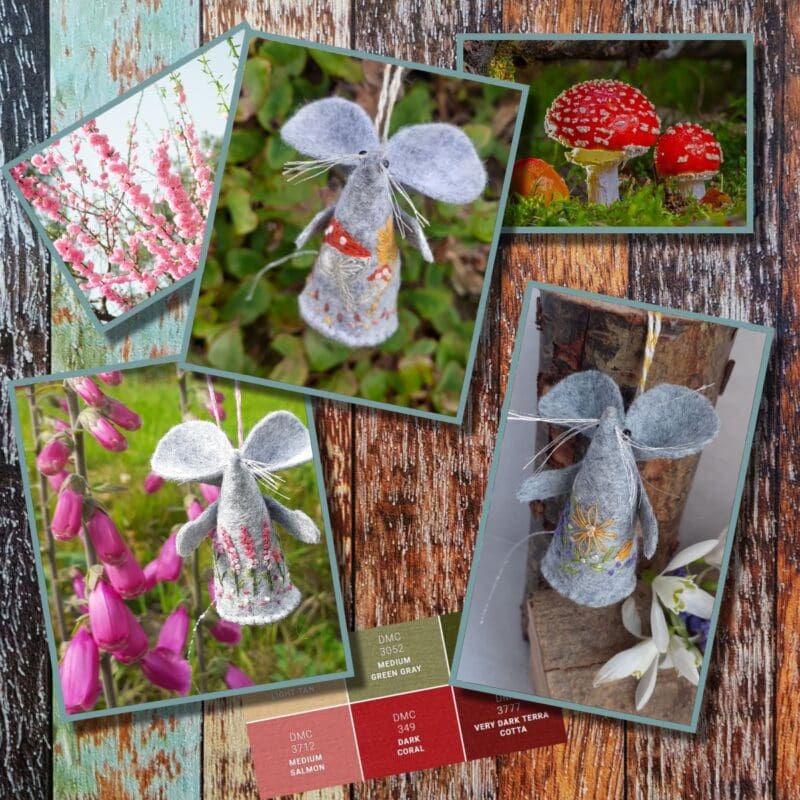
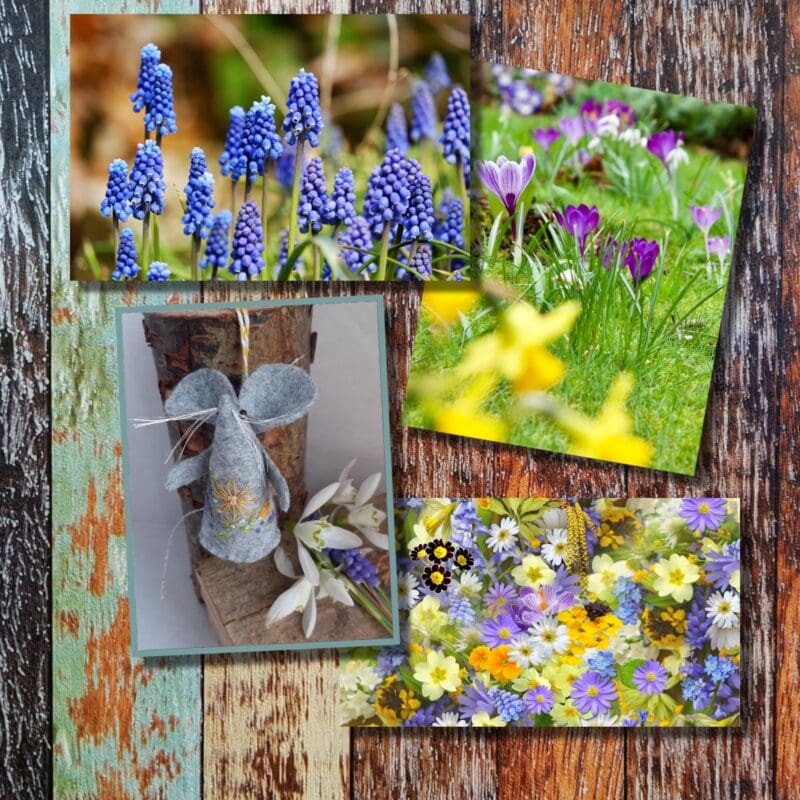
It felt natural for me to design my Seasonal Mice.  I started in Spring with the first embroidered Mouse, to me the colours of Spring are vibrant greens, yellows and blues.

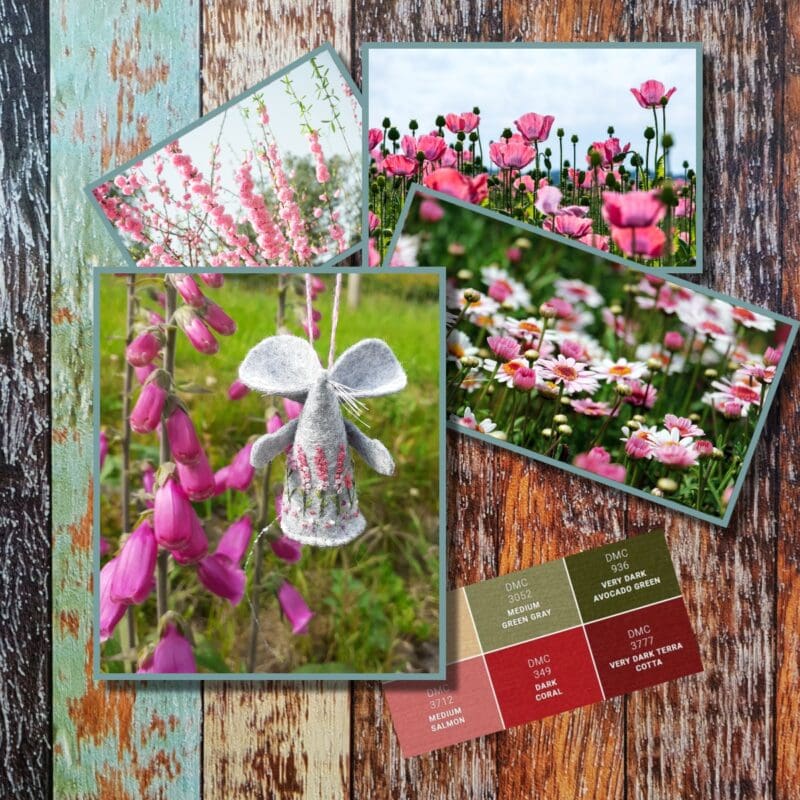
From there it was early summer, and the garden was full of pink foxgloves and the lavender was just starting to show some colour, I put together some ideas and came up with my Summer Mouse.

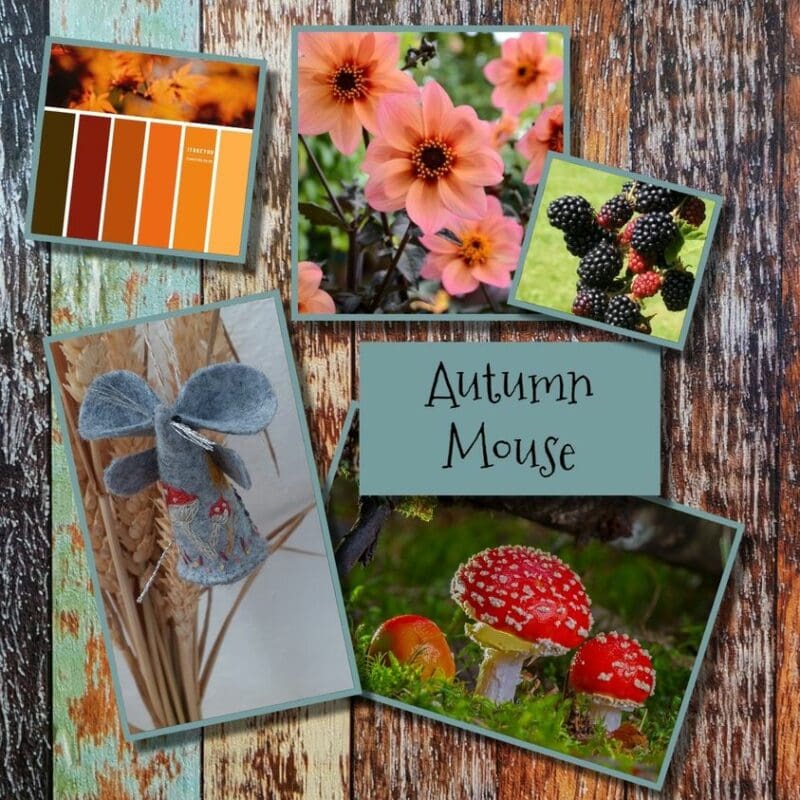
Autumn seemed to be coming quickly this year and my thoughts turned to a new mouse, not a harvest mouse but a celebration of the hedgerows with purple brambles, and spotty toadstools.  Also, I love late dahlias, so the brown stems and orange blooms were included.

And so, we are into autumn and the mornings are getting a bit crisp and chilly, so my next Mouse is of course Winter.  Still a work in progress but watch this space as they say!

I hope you enjoyed my seasonal mice; my hope is that they will become an annual feature of my work, but I won’t ever make too many of each, I just have an idea of the design and embroider them freehand so no two are ever totally identical. Next year’s may be different again.

Thank you so much for reading x